Showing posts with label Marcus Quintius Clavus. Show all posts

Monday, June 1, 2026

Nova Britannia Remote General Meeting Junius MMDCCLXXIX


Monday, June 1st, 2026 5:59 p.m. - 7:48 p.m.
Participants: Marcus Quinctius Clavus
Sibylla Ambrosia Fulvia
Marcus Livius Maruffus
Titus Ovidius Nonus
Numerius Octavius Astronomus
Aulus Iulius Paterculus
   M. Quintius Clavus and Sibylla Ambrosia Fulvia joined the meeting first, and M. Livius Maruffus joined them shortly thereafter, though it took him a few minutes to connect fully. During that time, I arrived also, and had a short conversation with Quintius and Sibylla about their current modern activities. Quintius mentioned that he was re-reading Colleen McCollough's series Masters of Rome.
   We moved on to the topic of Roman food just as Livius was able to join in. Quintius and Sibylla were speaking about their first introduction to liver and how they enjoyed it now as a shared meal. Sibylla commented that the Romans would also have eaten organ meat. I said that I thought that the entrails would be burned when an animal was slaughtered. Quintius replied that this was true of sacrificed animals, but that not all animals eaten would have been sacrificed, though for poorer people this would have been the majority of the meat they ate. Quintius said that especially in Greece, they ate a lot of pork, more than we eat in modern times, because pigs could be turned loose in the woods to feast on acorns, whereas beef was uncommon, because oxen were used to do work.
   Quintius continued to the topic of vegetables common in Roman times, mentioning the asparagus famously enjoyed by Augustus and that spinach originated in central Asia but was used in the Mediterranean by the time of the Roman Empire. It was around this time that T. Ovidius Nonus joined the call. Quintius mentioned that he knew so much about historical vegetables because he had been researching stuffed breads, which seemed to be a dish the Romans would have made.
    I mentioned that I had read recently in Plutarch's Moral Letters (for a philosophy discussion the previous weekend) that brides in a certain Greek city-state wore a garland of asparagus on their wedding day. Sibylla commented that she would prefer to have the asparagus on her plate. Nonus asked what the asparagus was supposed to symbolize. I reported Plutarch's analysis as being that marriage was like asparagus in that there was a long tougher part, like the stem, which you have to get through to reach the more tender part at the end. Quintius commented that it was the expectation, at least among the elites, in Roman times that married couples would grow to like one another over time rather than that they would be in love when they first married.
    We continued speaking about Roman topics. Quintius mentioned that Augustus had wanted to take the name "Romulus", but that he had been talked out of it, both because it was not particularly well-omened, as Nonus pointed out, and because there could only be one Romulus. I mentioned that by some accounts Romulus Augustulus was the last emperor of Rome, so it might be right to say that was a poor choice of name. Quintius added that that Romulus Augustulus had reigned as just a boy (hence the diminutive suffix "-ulus" in his name) and only for few months before he was displaced by the new Visigothic King of Italy.
    Quintius mentioned a documentary, Prophets of Doom, in which he and Mike from Legio III had participated for the History Channel, specifically a segment on the fall of the Roman Empire. Quintius still had a copy of the DVD.
     We talked a bit about Roman roads. Sibylla asked the interesting question of whether each side of the road was reserved for walking/riding in a particular direction, as on modern roads. Quintius said that he did not believe so, and that the roads were narrow enough that it would require people passing in opposite directions to squeeze past one another or for one to give way. He stated that when the army used the road, cavalry was typically on the shoulder so as not to wear out the horses' feet. He added that horseshoes had not been found for from this time period, and that it was unclear the Romans had them, though they had found hipposandals, which were thought to be for oxen (which would have needed to use the roads, since they would have been pulling carts and wagons).
     Quintius reported on some of the Roman roads which he had seen in England, including one case in which he had seen a modern road built atop a Roman one which diverged where the modern road curved away and the Roman one continued straight. Quintius clarified that the Romans could put curves in roads, something they would do to make climb easier on animals. Sibylla brought up the fact that not only Roman roads, but also at least one Roman bridge was still in use. Quintius recalled having heard of such an active Roman bridge in Spain and added that a Mycenaean bridge was still in use in Greece. I asked whether this Mycenaean bridge was built with huge cyclopean stone blocks, but Quintius replied that it was smaller than some Roman bridges. The book Route. 66 A.D. was recommended.
   Sibylla asked whether the Romans had anything equivalent to a bus: a vehicle which passengers could board at fixed stops. Quintius said he didn't think so, but that there were certainly places which would let you hire horses for the day, or a litter if you were in the city, for which a taxi would be a better analogy. Nonus reported that, according to Wikipedia, the Romans had ferries. Quintius agreed that it was possible to hire space aboard ships fairly easily and that this was a major mode of travel.
   Sibylla brought up Roman tourism, noting that people often traveled together in groups to be shown the sights. Quintius brought up Pausanias, whose reports of his touristing were the only record of sights now lost. Maruffus told us that the Romans loved to go see the pyramids and were famous for vandalizing them, though he was unsure whether the graffitti was still there.
   N. Octavius Astronomus joined the call around this time.
   Sibylla stated that the Romans were in general fascinated with things Egyptian and brought up the cult of Isis, which was quite different from the Egyptian cult of the goddess. Quintius replied that this cult represented the Ptolemaic adaption of Isis to Greek mythological and religious ideas. Nonus mentioned having seen a statuette of Isis-Fortuna, which brought us to the topic of the Interpretatio Romana.
    Around this time, 6:39 p.m., Zoom ended the first session of the meeting. Sibylla told us just beforehand that she would be heading to sleep, but the rest of us came back.
    Nonus asked about the latest session of Nova Roma's Senate. We discussed a few of the salient points, one of which was the fact that confirmations were now to be sent notifying citizens that their tax payments had been received.
    Nonus then started a discussion of whether it was worth paying Nova Roma's taxes. I said that the chief advantages were increased voting power and the ability to have official responsibilities within Nova Roma, something in which I thought Nonus might be interested.
    Quintius gave us a comparative view of some of the other organizations with which he was involved and their respective hierarchies, pointing out that each group had its own style of selecting officers.
    We looked over Nova Roma's page of job openings for things which might be of interest to those on the call. The second Zoom session ended, but Nonus & Maruffus came back to continue this investigation. Nonus requested more details on the Senate session, so we went over the transcript item by item, skipping the one under seal.
    We talked about ways about promoting Nova Roma, including some ideas by Maruffus about social media, about filming a commercial for Nova Roma, and about reinstating the "Roma" tag for the Forum Domitium, something Nonus had paid to make possible but which someone else (we were unsure who) would have to actually instate.
    We discussed future meetings for Nova Britannia, including the Latin meeting on June 15th and presentations for future meetings. Nonus said that in July he could give us a report on his trip to Egypt, which would test whether it would be worth expanding to a more detailed presentation for the Sodalitas Barbarica. Nonus mentioned that he had started learning the ancient Egyptian language years ago and might eventually try again.
    We talked briefly about our experience with Latin. Maruffus & Nonus had each studied the language a little in the past. I recommended listening to a reading of the chapter just before where the group had left off in Lingua Latina Per Se Illustrata to confirm it was a level at which they were able to understand a fair percentage of the vocabulary and grammar.

Sunday, April 26, 2026

After Action Report: MithraCon 2026 Day 3

Sunday, April 26th, 2026
Around 8 a.m. - around 12 p.m.
Participants: Marcus Quintius Clavus
Sibylla Ambrosia Fulvia
Marcus Cassius Julianus
Titus Ovidius Nonus
Erica
David
Aulus Iulius Paterculus
   Most of us awakened a bit earlier on Sunday than on Saturday. M. Quintius Clavus, Sibylla Ambrosia Fulvia, M. Cassius Julianus, T. Ovidius Nonus, and I went to breakfast at Patricia's again, but our new friends had breakfast at the hotel, which was part of a package deal with their room. Patricia's was a bit busier than the day before, but not by too much. We expected larger crowds to be arriving when church services ended. Patricia remembered many of our orders from the previous day. During breakfast, Nonus mentioned plans to stop by Denny's on the way home, and this opened up discussion of restaurants in Maine, storms & flash floods, and visits to Salem, Massachusetts. Cassius again paid for breakfast.
   We returned to the room and met with Dave and Erica again. Dave had brought a number of art pieces he'd created himself, including larger & smaller tauroctonies etched on wood, leather book marks, including one depicting the Mithraic grades, and images of the face of Mithras surrounded by rays. Cassius liked this last image so much, he requested permission to put it on the t-shirts for the following year. Dave offered the pieces for sale at a generous "pay-what-you-want" price. Nonus purchased a larger tauroctony, Cassius purchased everything not already bought by others and then gave much of it away.
   Those of us who'd been staying in the shared rooms packed up. Sibylla started the drive home, while the rest of us, including David & Erica, headed to the Yale University Art Gallery. While walking we talked. Erica told me about her hobbies; I mentioned reading some poetry by William McGonagall (https://www.poetryfoundation.org/poets/william-mcgonagall). We noted an independent bookstore along the way which had seen visits in previous years.
   At the museum, we looked at the Classical artwork and the finds from Dura Europos, but also ventured into some other exhibits. Next to the Classical exhibit was a gallery of early modern currency; of particular interest was a series of coins struck with the image of Liberty/Libertas. I left the group briefly in order to make a call and stumbled into a room of Pre-Columbian Mesoamerican artwork, which I encouraged the others to check out, and they also appreciated the works we saw.
    At last we bid each other goodbye. Cassius had let me store the leftover fruit in his car when we'd packed up the room, so we headed back together. We stopped at the bookstore along the way. Cassius made a number of purchases, and I collected two books from the "Free Books" bin, one of which was Murder on the Appian Way by Steven Saylor. I thought some of our other friends were browsing there around the same time, though we didn't actually greet one another.
   Cassius and I said our farewells back at the hotel parking lot, both agreeing that we looked forward to seeing everyone again in the near future.

Saturday, April 25, 2026

After Action Report: MithraCon 2026 Day 2

Saturday, April 25th, 2026
Around 8 a.m. - around 10 p.m.
Participants: Marcus Quintius Clavus
Sibylla Ambrosia Fulvia
Marcus Cassius Julianus
Titus Ovidius Nonus
Aulus Iulius Paterculus
David
Erica
   M. Quintius Clavus woke up well before most of the rest of us. A bit after Sibylla Ambrosia Fulvia had also awakened, Quintius dropped by to check on everyone else. Within a few minutes we had all showered and were ready to go to breakfast at Patricia's, the restaurant next to the hotel. It was bit less packed than usual, probably because we'd arrived early.
   Patricia herself remembered our group and was surprised it had been a year already. I asked whether Patricia's was older than MithraCon. Sibylla (who was the only one to have attended the conference since it first began) didn't know, as the earliest MithraCons had taken place in a different location. M. Cassius Julianus generously treated everyone to breakfast.
   Sibylla remained at the hotel room while the rest of us headed down to the Sterling Memorial Library. Once we arrived at the library, we headed off in different directions. Quintius had already renewed his library pass online and headed off to do research. Cassius went to the desk to renew his pass. T. Ovidius Nonus & I examined an exhibit of errata (https://events.yale.edu/event/beauties-of-my-style-errata-and-the-printed-mistake) (emendations appended to books to correct printers' errors). Nonus afterwards walked to the Yale Peabody Museum, while I went to the Bass Library downstairs.
   In the Bass Library, a display showed students who'd worked at the library were being honored by each receiving a nameplate in a book of choice. A Classics student had selected the Thebiad by Statius. I looked through a number of different collections while in the Bass Library: in the graphic novels section, I attempted to find the graphic novel adaption of 1177 B.C., which Quintius had recommended the preceding night, mentioning to us that he had gone to a talk at which he'd had his copy signed by the illustrator.
   At the Peabody, Nonus told some other visitors about Mithraism when they were discussing sun gods. He later took an Uber back to the hotel due to the rain. 
   After stopping at The Yale Bookstore, I returned to the room, only to find some new people had joined us and were engaged in conversation with Sibylla & Quintius. They introduced themselves as Erica & David. David had been informed of MithraCon through Reddit (where he'd also posted an etching he'd made of the tauroctony (https://www.reddit.com/r/Mithras/comments/1s2kd58/tauroctony_designed_and_etched_by_me/) and the two of them had decided to come up to check it out. It had required some detective work on their part, as the hotel staff didn't know about MithraCon when asked. They finally met Sibylla in the lobby wearing her MithraCon t-shirt. David told us that the person who'd told him about the conference had tried to attend as well, but had gotten discouraged at not being able to find us and left.
   Quintius told us that Cassius was still at the library because he'd found a book in Italian he was trying to scan into Word for ease of translation. We talked about various topics until Cassius and Nonus returned, and carried on when they came back. Erica & Sibylla both had experience in the medical field which gave them shared material for conversation. We talked about the Masons and about different Christian denominations. David shared a song (https://soundcloud.com/user-430526764/oh-mithras?si=79ffaab719cc4943adfdab8f9101f9bf&utm_source=clipboard&utm_medium=text&utm_campaign=social_sharing) which a friend of his, a talented musician, had set to music at Dave's request. Cassius recommended Andrew Fear's book and highlighted the shortcomings of the book he'd brought with him.
   We decided it was time for dinner. Sibylla had brought chicken & Caesar salad, Quintius almonds & dried fruit, Cassius plenty of stuffed grape leaves. Nonus brought lupini beans which he'd been saving for this occasion. I brought fresh fruit: grapes, apples, & a pineapple*. Cassius sent a photo of the pineapple to Pattie.
   Nonus read us his carefully researched essay on the gladiatorial diet, which he'd finished and sent to be graded that very weekend. One key point he made was that gladiators were not vegetarians, as we know from direct literary evidence, but that it appeared that way because the vast quantities of beans in their diet reduced the amount of nitrogen in their remains.
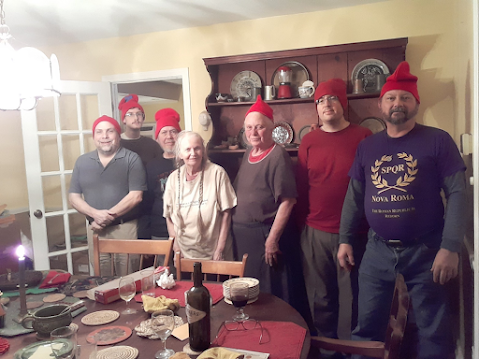
   David had handmade phrygian caps which he gave us to wear for a group photo. We discussed the gladiatorial reenactors who'd once been in New England.
   After we'd cleared away the dishes and leftovers, some left the room while a Raven grade initiation took place. After that was complete, Nonus, Cassius, and I talked a bit longer about polytheistic religion before going to sleep.   

* This was a nod to Vermaseren's identification of a sculpted object included on a Mithraic statue as a pineapple, which we had seen and commented upon the previous.

Friday, April 24, 2026

After Action Report: MithraCon 2026 Day 1

Friday, April 24th, 2026
Around 3 p.m. - around midnight
Participants: Sibylla Ambrosia Fulvia
Marcus Cassius Julianus
Marcus Quintius Clavus
Aulus Iulius Paterculus
Titus Ovidius Nonus
   I arrived somewhat after 6 p.m., asked at the front desk, and was given the room numbers for the conference, along with a key card. Sibylla Ambrosia Fulvia, M. Cassius Julianus, & M. Quintius Clavus had already been talking for some time. Sibylla had arrived first in the early afternoon to set things up. Cassius, who had arrived afterwards, had set up a tauroctony in one corner of the room, consisting of both a canvas image of the bull-slaying and a bronze statue of the same, set up on a table. On the counter on the other side of the room, he'd brought some of his small antiquities for sale in their portable display case.
   We spent only a little further time speaking up in the room before deciding to head down to dinner. We passed through the lobby, where Sibylla told the staff that T. Ovidius Nonus was expected to arrive later that night, giving them his macronational name. Across the street, we had dinner in the same Japanese restaurant where we'd eaten the previous year. While waiting for and during the meal, we discussed various topics. Cassius told us about an antique urn he'd purchased as part of his antiquities trading business, only realizing after it arrived that it was enormous. Sibylla told us about the farmer's markets which were soon to resume, her process for inventing new spice blends, and the fact that really hot spice blends had to be made by her colleagues, as even mixing them exposed the mixer to their heat.
   At the end of the meal, the waiter brought us an unexpected treat - eight French-style macarons. We had a few with the tea which had been shared by the table and brought the rest up to the room.
   We stayed up talking a while longer. Cassius gave out t-shirts with an image of the taurontony on them. Cassius also offered to give away his extra copy of a book on Mithraism which he had accidentally bought twice, but he reviewed the book so unfavourably that no one wanted it even for free. Then we set up the beds. I went down to the lobby & lingered there until after 11 p.m. Nonus arrived a bit afterwards.

Monday, January 12, 2026

Nova Britannia General Meeting: Ianuarius MMDCCLXXIX


Monday, January 12th, MMDCCLXXIX, 6:00 p.m. - 7:20 p.m.
Participants: Sibylla Ambrosia Fulvia
                    Marcus Quinctius Clavus
                    Aulus Iulius Paterculus
                    Publius Sextius Laevus
   Sibylla Ambrosia Fulvia and I joined the call first. I suggested to Sibylla that we might use this session to plan a few presentations for later in the year. M. Quinctius Clavus joined just as this proposal was being made, and it was repeated.
  P. Sextius Laevus also came on the call briefly. However, there were apparent technical issues which appeared to prevent him from speaking and to kick him out each of the two times he attempted to join.
   I asked whether either Sibylla or Quinctius had any agenda items they wanted to discuss. Quinctius mentioned that he would like to correct his display name in groups.io to show his Roman name rather than his English one (using the official version "Quinctius", rather than "Quintius", as we'd been accustomed to call him). As it turned out, we were able to do this on the shared screen right away, at least for the Nova Britannia list (https://groups.io/g/NovaBritanniaProvincia). Quinctius mentioned that the Nova Britannia list and the Main List (https://groups.io/g/TheForumRomanum) were the only groups to which he subscribed on groups.io, so it made sense to use his Roman name there.
   I expressed surprise that Quinctius was not on the list for Sodalitas Militaris (https://groups.io/g/sodalitas-militaris). He said that he might stir up some controversy there, especially over the optio's helmet, as many reenactment groups used the wearing of two plumes on the helmet as a distinctive badge of office for the optio, something that Quinctius said had little if any historical basis.
   This lead to a discussion of Roman helmets, with Quinctius providing most of the information as Sibylla & I asked occasional questions. Quinctius recommended the book Army of the Roman Emperors by Thomas Fischer, citing it frequently in the information he told us.Among the Fischer's theories which Quinctius thought credible were that a lot of helmets which had been found were contemporary rather than styles which had succeeded one another. In writing the book, many Eastern European helmets otherwise little reported in English-language texts had been studied, including the one example with a crosswise crest. By contrast to this singular example, many helmets with side plumes had been found, which made it unlikely that this was a mark of rank unless a disproportionate number of optiones were losing their helmets.
   Sibylla asked whether there were different regional styles. Quinctius answered that there did not seem to be much regional differentiation in helmets within the Roman army, but there was some evidence of different belt styles for different legions.
   Sibylla asked whether armour was provided to soldier or bought by them. Per Thomas Fischer, Quinctius said, these would have been bought by soldiers on installment plan. One legionary's mother was given money when his armour was sold back to the army. It was in the 1st century that this would have been deducted from pay, during the 4th century such armour had to be bought directly. It would have been bought back when soldiers left the army, as they wouldn't necessarily need their armour and might not have been permitted to take their swords. Armour which had been found with multiple names marked into it showed that the same suit of armour was reissued.
   I asked whether there were restrictions on who could be armed with swords, outside the city of Rome itself. Quinctius replied that it depended whether swords were actually needed, and gave the example of recent colonies such as Britain and Pannonia as places where former soldiers had been settled together and where they might retain weapons into retirement. Pannonia, Quinctius added, was incorporated under Augustus, while Caesar re-founded Corinth (which had been destroyed at around the same time as Carthage) as a colony.
   Sibylla asked about armour found in Teutoburg Forest. Quinctius reported that there were a few plates found, as well as one near-full set of armour on buried body. This was the second near-full set to be discovered, a rare and unusual find, and was on display in the local Kalkriese museum. These finds had actually help persuade archaeologists that segmented armour was in use earlier than previously thought.
   Sibylla asked where the armour was made. Quinctius answered that there were shops that supplied armour and cloaks to the troops: local businesspeople were recorded as selling it. It was only in Late Antiquity that state-owned fabrica were employed for supply. I wondered, though did not say, whether the private manufacture of items worn by the troops could have enabled others to impersonate soldiers, and what the penalty would have been for doing so.
   The conversation turned to army transport, which Quinctius told us was independent from the civilian system and which employed rivers when possible, as water transport was much cheaper than land. This lead to a conversation about canals, ancient and modern. There was an old canal near Quinctius, of which the most noticeable remnant was "Canal Street". We wondered whether the Erie Canal was still in use (the answer appears to be yes, based on brief subsequent research, but the modern canal is somewhat different than the original one and sees less commercial traffic). Quinctius brought up the canal at Corinth.
   We discussed Roman concrete and differences between Roman and Medieval stonework. Quinctius noted that Roman stonework was smooth and even, while Medieval stonework was more often of differently shaped stones.As further points of comparison, Sibylla brought up Inca & Aztec stonework.and Quinctius the Cyclopean walls of Mycenaean cities, both cases in which close-fitting stones were laid together without the need for mortar.
   We also talked about how later people often cannibalized old monuments for their stone. Sibylla mentioned the pyramids, while Quinctius mentioned that certain parts of Hadrian's wall had vanished because local farmers had repurposed much of the materials. Quinctius also mentioned a Roman gravestone had been incorporated into the foundation of a church.
   Quinctius stated that the remains of most Romans whose tombstones were still in existence had been lost, but that the ashes of Marcus Favonius Facilis were believed found under their marker.
   For my part, I said that I would be pretty nervous about having a gravestone incorporated into my house and that I was surprised that the Medieval or early modern people reusing these stones were not more concerned about being haunted. Quinctius expressed doubts that people of the time of which he was speaking would have been concerned about ghosts of an earlier and different culture. I mused aloud that incorporating a gravestone into a church might have been seen as less risky than building it into a private home.
  Sibylla asked about Roman beliefs about ghosts. I mentioned the book Greek and Roman Ghost Stories by Lacy Collison-Morley, but wasn't able to remember many details from it. Sibylla said that a story of a Roman ghost awakening in Medieval or early modern times due to reuse of a gravestone would be an interesting story. Quinctius recalled a short story in the ebook sequel to "The Legions of the Mist" by Amanda Cockrell (https://www.amandacockrell.com/) with a somewhat similar premise.
   We talked a bit about the beliefs of modern people concerning ghosts. Quintius mentioned taking a class on religiously unaffiliated people, in which he'd learned that a significant minority of people who did not believe in Heaven or Hell still believed in ghosts. Sibylla and Quinctius each told stories of things which had been experienced by people they knew. I suggested that "Ghost Stories from Ancient Times" might be a good topic for a presentation, and Quinctius said he might be able to research the topic, but that it would have to wait until later in the year. (It wasn't said at the time, but October might be a good time.)
   Sibylla asked whether the Romans would have had option for storage of goods by private individuals, analogous to the storage units we have in modern days. I was doubtful that this was as in-demand in ancient times, and Quinctius could not recall an exact analogue, though he did speculate that it might have been possible to rent space in a warehouse. With respect to the military, Quinctius mentioned the mansiones as a system of transportation and storage.
   Sibylla brought up weekends in Roman times. There were no weekends for most Romans during Classical times, as a day of rest was a Jewish & Christian tradition. However, Saturdays were observed in Israel. Quinctius said that even slaves & animals had Saturdays off, per Torah. Quinctius & Sibylla each also mentioned lengths to which observant Christians & Jews would go in modern times to keep from working on their respective holy days. 
   We talked a bit about the Jewish diaspora. Quinctius mentioned a few places with significant Jewish communities: Alexandria, Rome (especially trans Tiber). Quinctius also stated that Caesar supposedly knew many Jews as a result of growing up in the Subura. 

Saturday, December 20, 2025

Saturnalia 2778 - December 20th, 2025

Saturday, December 20th, MMDCCLXXVIII, Approximately 10:00 a.m. - 8:10 p.m.
Participants: Sibylla Ambrosia Fulvia
                    Marcus Cassius Julianus
                    Marcus Quintius Clavus
                    Aulus Iulius Paterculus
                    Numerius Octavius Astronomus
                    Titus Ovidius Nonus
   The evening before, on December 19th, there had been a major storm. The power went out in the home of Sibylla Ambrosia Fulvia, where our meeting was to take place. M. Cassius Julianus, who arrived after dark, had not been able to call ahead and had seen downed trees along the way, giving some hints of what had occurred. Nonetheless, Sibylla and Cassius had made the best of the situation, going to a nearby restaurant for a dinner of fish & chips that night and out for coffee (and water) in the morning of December 20th.
    M. Quintius Clavus and I arrived around 10 a.m. Quintius was aware of the situation, having checked the power outage map online and spoken with Sibylla by cell phone the previous night. Sibylla and Cassius greeted us outside and led us through the garage to sitting room, where the hearth was blazing. We had a lengthy conversation, which went into the current situation and our daily lives as well as into Roman topics.
    We discussed fiction series: the Masters of Rome series by Colleen McCullough (which Quintius, Cassius, & I loved and which Sibylla had yet to read) and the Karus Saga by Marc Alan Edelheit (of which I had just finished the first book, Lost Legio IX). Cassius recommended the Destroyermen series by Taylor Anderson as a similar tale of people from a specific historical period being transferred to another world, adding that though the premise sounded a bit silly, everyone to whom he'd recommended it had enjoyed it. I stated that this reminded me of the Codex Alera series, which had been the result of a deliberately silly prompt (Lost Roman Legion plus Pokemon) being given to the author, Jim Butcher, only to become a success.
   Quintius spoke about a nonfiction book, The Inheritance of Rome by Christopher Wickham and its thesis that much more of the Roman Empire survived into the Middle Ages than was commonly thought.
   Contemplation of the fire brought Nero and Crassus the Rich to mind, and there was some thoughtful discussion of them, including whether either might be considered underrated or misunderstood. Cassius and Quintius agreed that Nero was a more complex figure than generally appreciated. Quintius pointed out that Nero's mother had attempted to rule through him while he was quite young and Cassius said that the remnants of Nero's Golden House had the feeling of a profoundly sad place. I argued that having Crassus around to purchase and then save burning buildings was an improvement over having no fire department at all, which elicited what looked like an appalled expression from Cassius, though he conceded some truth to it, at least for those not personally obliged to sell under those conditions.
  A little after noon, the power came back on. We had called N. Octavius Astronomus earlier to let him know that the plan to contact him through Zoom might not succeed due to the outage, but when 1 p.m. arrived and we were able to connect to the internet, we called to see whether he would be able to join after all. Just after he agreed to connect through Zoom and hung up, the power failed again. We called back and spoke to Astronomus on speaker. Astronomus shared his goals with his continuing education at the university, and stated that he hoped to study and possibly one day move abroad. There was some discussion which followed, especially between Astronomus and Sibylla, about learning languages and differences between Norwegian and Swedish. Eventually, Astronomus had to go, in case there was someone who wanted to see the next presentation at the planetarium where Astronomus worked, which were scheduled for every half hour.
  Cassius reported briefly on happenings in Byzantium Novum, noting that they had members as far away as Thailand and that there had been a number of Zoom meetings, with a few offline ones as well, though none Cassius had personally had the chance to attend thus far. Cassius also mentioned that one citizen of Byzantium Novum had attended MithraCon in a previous year.
   This prompted me to ask whether Mithraism had persisted into the Byzantine Period. Cassius answered that it had, and this led into an extended discussion on religion.
   Quintius recounted some events which had transpired during past reenactments, and Cassius recalled that one of the legionaries mentioned in the anecdote Quintius was telling had left behind his armour and some other items, which Cassius had in storage, waiting for some other legionary to take them one day.
   Sibylla and Quintius talked about the SCA. Sibylla shared some activities of members of the SCA in the Navy which had taken place over the years. One such incident involved the U.S. SCA folks appearing on deck in their period garb, thus baffling the Russians known to be spying on them. Quintius described judging the "Artifacts of a Life" contest, which had required creating and using a number of items which would have belonged to a specific person at a specific time and place in history, then describing how these objects illustrated the life of that particular person.
   Eventually, we decided to serve the dates, figs, and almonds, snacking on these items as we continued our conversation.
   We had been checking the driveway periodically, as T. Ovidius Nonus had said he would arrive around 3:00 p.m. He arrived a little later, and joined us next to the fire. He was dressed in a tunic, which was impressively historical-looking. After greetings, introductions (Nonus and Cassius had already met), and a brief tour of the premises, Nonus told us a bit about his interests in permaculture, archaeology (which he hoped might become a career), and religion, as well as his experiences in Nova Roma thus far. Quintius advised that Vindolanda in Britain was always looking for more people to help them excavate.
   The power came back on again around dusk, somewhat after Nonus arrived.
   Nonus served the bread he had brought along. Sibylla brought out some grapes and wine as well.
   Nonus was interested in becoming an augur and was doing an exhaustive reading of primary sources, but had not yet found the guidance for which he'd been hoping on how to pursue this study within Nova Roma. I noted that Nova Roma required holding a more junior priesthood before moving on to a senior one, but  suggested reaching out to Flavius Vedius Germanicus for advice on how to get started.
  Sibylla highly recommended the M. Didius Falco series, highlighting how each novel illuminated a different facet of Roman life.
  Quintius said that the railroad gauge being based on the width of Roman roads (something which we had just discussed during our December MMDCCLXXVIII Remote General Meeting) was an old wives' tale.
   As the power had come back too late for us to do the cooking we had intended, three pizzas were ordered. Cassius very generously paid for the meal, and went with Quintius to retrieve it.
   I asked Cassius about planning for a potential conventus in Maine. Cassius listed what was available in his vicinity: his office, space in his apartment in which a few guests could conceivably stay, the local Oddfellows Hall, and hotels in which people could also rent rooms. Sibylla and Quintius were both somewhat skeptical that this was feasible, but offered some helpful thoughts. Cassius, reflecting on what Quintius said would be needed both (indoor and outdoor space, as well as insurance), said that the best thing might be to rent a private campground during the off-season. Quintius mentioned that Nova Roma expected people to dress in Roman garb, and Nonus suggested having a garment-making workshop as part of the event. Cassius agreed to discuss the topic further with Astronomus and me after the holidays. Nonus asked to be included in these communications as well. 
  Nonus had brought along a game of Yahtzee. (Out of curiosity, someone looked up how Yahtzee go its name. The answer found: it was originally played on yachts!) He had also brought some recreated tesserae, six-sided dice made from bone. He mentioned that they were not balanced, compared to say, the casino-grade dice he had considered bringing. Indeed when we rolled them, they seemed reluctant to roll threes and twos, but they had a nice feeling in the hand, rather different from plastic dice. While Cassius was up checking something, we agreed that the prize to the winner would be the remaining half bag of almonds. Cassius won, and I handed him the prize, which he said he could enjoy on the ride back to Maine. He later commented that when he was told he won a prize, he thought he might have been selected for human sacrifice (a la Shirley Jackson).
  I mentioned that now that there were four relatively active citizens based in Maine, they might have some regio-level gatherings in addition to those they participated in as part of Nova Britannia as a whole (and the conventus we one day hoped to host for Nova Roma as a whole). Cassius was thoughtful and begin talking with Nonus about the possibilities for a casual meeting.
  Quintius and I left soon after the game finished. On the ride back to his house, Quintius told me about a four book series he had been reading set in Roman Britain.

Monday, December 15, 2025

Nova Britannia Latin Meeting: Decembris MMDCCLXXVIII

Monday, December 15th, MMDCCLXXVIII, 6:00 p.m. - 7:00 p.m.
Participants:    Sibylla Ambrosia Fulvia
                        Marcus Quintius Clavus
                        Publius Sextius Laevus
                        Aulus Iulius Paterculus
   The meeting began, as expected, with discussion of Nova Britannia's Saturnalian festivities on Saturday, December 20th. Sibylla Ambrosia Fulvia confirmed that M. Cassius Julianus would be coming down from Maine, as would T. Ovidius Nonus. M. Quintius Clavus and I were expected around 10 a.m.
    Sibylla mentioned some of the food & drink which would be awaiting her guests, including chicken and celeriac, wine & shrub. Quintius asked who liked asparagus: the answer was everyone present. P. Sextius Laevus declared that he liked everything; I asked him whether he would have some dormice should we serve it at some future event he was able to attend. Laevus confirmed that he would, and clarified that any food people ate as part of a regular meal (rather than as a college prank) he'd be willing to try. Quintius said he would be ready to have some dormice as well.
    Laevus shared with a us quote: "PONE MERUM ET TALOS PEREAT QUI CRASTINA CURAT MORS AUREM VELLENS VIVITE AIT VENIO" from the Copa Vergiliana. Laevus also referenced a link he had shared on the Nova Britannia list. The creator of this YouTube channel presented a Latin word each day and, for the month of December, a quote as well.
    Quintius departed, and the rest of us talked for a little while longer before we settled into our Latin study. We read up to page 70 of Familia Romana, near the start of Capitulum X. In the course of this study, we wondered whether ovis was a word which could refer only to female sheep. (Based a double check later that night, it appears so.)
    Just before the call was to end, I asked whether we planned to set up a Zoom meeting as part of our in-person meeting. Laevus said not to do so on his behalf, as he would be quite busy Saturday, but he would try to come on briefly if possible should we decide set up a such a meeting for other reasons, and that an earlier time would make this more feasible. Sibylla said that if such a meeting was scheduled, it would be a good idea to share the link on the Main List, so that any Novi Romani who wished to attend could do so.
    The night ended with an early round of Io Saturnalia!

Monday, November 3, 2025

Nova Britannia General Meeting: Novembris MMDCCLXXVIII

Monday, November 3rd, MMDCCLXXVIII, 6:00 p.m. - 7:38 p.m.
Participants: Publius Sextius Laevus

Sibylla Ambrosia Fulvia

Marcus Quintius Clavus

Numerius Octavius Astronomus

Aulus Iulius Paterculus

   When I joined the meeting, P. Sextius Laevus was already present. He asked whether I had seen the link which he had posted to a Latin Halloween story (https://beluosus.dreamwidth.org/544998.html) in Discord. I replied that I had seen this link both there and on the Nova Britannia list, though I had not read the story itself. I asked whether he wanted to make an attempt to read it during our Latin meeting later that month, and he replied that it depended on what others wanted to do, as it might make for slow reading. I agreed, recalling that our last attempt to read a story by the same author, while entertaining, had been rather challenging.

   Sibylla Ambrosia Fulvia joined the call, followed shortly thereafter by M. Quintius Clavus. We had a short conversation on several modern topics, including vacination and various wildlife which people had encountered both close to home and while on trips. Quintius reported seeing bighorn sheep, rocky mountain goats, coyotes, and a wolf on trips in the Black Hills and Canada. Sibylla also brought up the issue of Quintius' car, which as it turned out had given out entirely. This meant that Quintius would need a ride to Sibylla's house for Saturnalia.

   Sibylla brought the topic back to Roman things, asking what each of us had been looking into recently. I mentioned having begun a fantasy audiobook about the Legio IX Hispania and its teleportation to another plane of existance (Lost Legio IX by Marc Alan Edelheit).

   Laevus shared with the others what he had been telling me about the story he'd read, and mentioned that it referred to a real Roman town which had been excavated near Cambridge, Durobrivae. He mentioned that there was a Wikipedia page and three YouTube videos (https://youtu.be/fbjnzTjBP58?si=W38wJk8mPKKPgywU ; https://www.youtube.com/watch?v=z_CCsWf1c9w ; https://www.youtube.com/watch?v=0TeCQhuTZVM) about it.

   Quintius talked about reading some letters sent by a Roman soldier who had attempted to join Legio III Cyrenaica (in ancient times, not our Legio III!) and was sent into the Navy instead before finally gaining the deployment he wanted. Laevus asked for the link to these letters.

   There was some discussion about the authorship of the gospels of Luke and Matthew based on the language, with Luke appearing to be a native Greek speaker while Matthew was not. Laevus mentioned a desire to learn Greek, but noted that there was not really time to pursue such a gramatically complex language at the moment, in addition to Latin. There was some conversation about the evolution of the Christian Church. Sibylla brought up the cult of Isis, and Quintius made the point that the Isis brought to Rome was a thoroughly Hellenized version of the goddess as a result of Ptolemaic influence. Laevus mentioned that he would like to have an in-depth religious discussion with a cultor or cultrix deorum. Quintius talked about a book he'd read about Roman army religion in Britain, including both Roman and indigenious British deities. He mentioned that the cult of Mithras appeared to draw mainly from the ranks of centurions, while lower ranking soldiers tended to worship a British god who was similar in certain ways.

   The call was cut off here. Laevus and Quintius rejoined, but Sibylla did not, presumably having gone to bed. Astronomus joined soon after, having just arrived back home from college.

   There was a bit of personal discussion, and Laevus told Astronomus a bit about the Halloween story and the town of Durobrivae, as Astronomus had been absent for the earlier conversation.

   Quintius said that he recognized the name, though he might not have been able to place the town on a map. He said he might have passed near the town on his trip to England. Quintius told us about some of the ruins he'd visited on that occasion, one of which was in a cowfield entered through a "kissing gate" (designed so that humans could pass easily while humans could not), which the tour guide had complained was not being maintained. Astronomus shared the YouTube channel of Paul Whitewick (https://www.youtube.com/@pwhitewick), who took viewers through some of these ruins in the British countryside.

   Laevus talked about having steped on the ground of the old Roman forum in one English town he visited, much to the annoyance of the residents of the home above, who had tourists traipsing through their house all the time. Astronomus said that the fact that it was underground showed how the ground had settled. Quintius remarked that this was much like the underground part of Seattle, which had similarly been buried through the passage of time.

   The meeting ended again, and this time Laevus did not come back. Quintius and Astronomus talked about upcoming events. Sibylla would be at Changing Times Changing Worlds (https://ctcw.net/ctcw-2025-speakers/). Quintius would be at the Worchester Art Museum November 22 (https://www.worcesterart.org/exhibitions/arms-and-armor/), but possibly not on December 13 when others from Legio III Cyrenaica would be there (https://www.worcesterart.org/events/arms-and-armor-up-close-legion-iii-cyrenaica/), due to the car troubles. Astronomus expressed a desire to gather some citizens to visit the Worchester Art Museum together for one of these events. We also talked about Saturnalia, and Quintius confirmed that there was no conflict for him after all, meaning it would probably be the weekend of December 20th-21st.

   There followed a discussion of the evolution of Roman helms and armour. Quintius cited Thomas Fischer (https://www.oxbowbooks.com/9781789251845/army-of-the-roman-emperors/) as an opponent of the school which believed in a more "linear" evolution.
  

Monday, October 20, 2025

Nova Britannia Latin Meeting: Octobris MMDCCLXXVIII

Monday, October 20th, MMDCCLXXVIII, 6:00 p.m. - 7:03 p.m.
Participants:    Sibylla Ambrosia Fulvia

                        Publius Sextius Laevus

                        Marcus Quintius Clavus

                        Numerius Octavius Astronomus

                        Aulus Iulius Paterculus

    Early in the meeting there were in-person congratulations, first by M. Quintius Clavus and then by P. Sextius Laevus and me, of Sibylla Ambrosia Fulvia on her adlection to the Senate. There was some discussion of what responsibilities this entailed, which it was agreed would also be posted in written form on the Nova Britannia list for future reference. Sibylla promised to be a voice for Nova Britannia in the Senate and told everyone to let her know their concerns.

    Quintius then left the call to enjoy dinner. I noted that it would be good to have a version of the phrase " Bon appétit" in Latin, but no one knew it.

    The three of us still present on the call spent some time reading and translating from Familia Romana. We read from the start of Capitulum IX to line 74, leaving on a cliffhanger: the words "Lupus collum ovis petit dentibus..."

    We decided to end the Latin session there, and were cut off just as Laevus was about to make some final comment. I returned just in case Laevus wanted to come back and finish what he was saying.

     This was fortuitous, because shortly thereafter, N. Octavius Astronomus joined the call. Astronomus explained that he had just returned home from school and asked whether there was any vital news in Nova Britannia. I commented on Sibylla's adlection and we discussed this for a while, as well as how the censors usually post the results of the census in general. Astronomus was struck by the fact that the censors hadn't contacted Sibylla beforehand, but had left her to discover her new status along with everyone else.

    Astronomus gave some updates on his work as Triumvir monetalis, working alongside Gnaeus Cornelius Lentulus and Marcus Octavius Corvus to plan the creation of new Nova Roman coins. Astronomus said the process was going well but slowly, with the cost of the project being a large factor and an ongoing debate on whether to use modern or ancient minting methods. He added that the reception and use of the new coins by citizens was a major consideration. Astronomus also said he'd communicated with some Rome enthusiasts outside Nova Roma for advice on the project.

    Astronomus asked whether there had been any progress on the conventus. I said there had not, but that I had not tried to get in contact with Cassius recently and should reach out again.

    Astronomus described his busy schedule, but said that he would try to make at least one meeting a month and that he would try to let people know if he was planning to attend, so that we knew to wait for him. He sent greetings to everyone, saying to let them know he was still here.

Monday, October 6, 2025

Nova Britannia General Meeting: Octobris MMDCCLXXVIII

Monday, October 6th, MMDCCLXXVIII, 6:00 p.m. - 6:56 p.m.

Participants:    Sibylla Ambrosia Fulvia

                        Marcus Quintius Clavus

                        Aulus Iulius Paterculus

   Upon joining the call, I asked Sibylla, who was already present, "What's new?"/"Quid novi?" She responded to both the English and Latin version of the question with a shrug.

   This prompted me to ask whether the shrug was used in ancient Rome, noting that in ancient Greece we knew nods to have a different usage than in most of the modern West. Quintius, who had joined about this time, concurred that nods and other gestures were different in ancient Greece. Quintius added that Jan Fraizer, whose YouTube series on Alexander the Great Quintius had found very enjoyable, had gone into this topic, as had some historical novels. However, the gestures used by the Romans had not been explored by the same sources. Quintius did comment that the shrug in particular was sometimes associated with the Jews. I wondered aloud how far back any such cultural connection might have gone.

  This lead to a discussion of Jewish history, and particularly of the Babylonian exile. Quintius clarified that the Babylonians had actually taken two groups of Jews captive at different times, both times primarily elites, while much of the lower class was permitted to remain in Israel. Quintius stated that these captives did not appear to have been enslaved, and added that slavery was somewhat less pervasive in Babylon than in Rome, though still extant. Also discussed was the origin of the Jewish diaspora with these events and the decision of some communities of Jews to remain abroad when the Persians ended the exile. Quintius wondered how far back the synagogue found at Dura Europus might have been found to date.

  I commented that the Romans also would probably not have enslaved members of a foreign elite, even if they were taken captive, as this would have compromised the broader project of co-opting the elites of subject peoples. Quintius agreed, citing the examples of Arminius taken as a hostage for his father and the of Claudians an elite clan of a non-Roman (non-Etruscan) people which had joined the Romans back in the Regal Period.

  I then asked about plans the others had for the Autumn season. Sibylla stated that farmer's markets were tapering off for the year. Quintius stated that he would be attending the East Kingdom Coronation for the Society of Creative Anachronism in Wooster, followed by the Providence Columbus Day Parade with Legio III Cyrenaica. He commented that it might rain, and that while they would march rain or shine, it was a bit miserable dealing with wet armour.

  This led to conversation about the weather, which Sibylla deftly brought back on topic by asking whether there had been frost in Rome. Both Quintius and I asserted that there had been. Quintius more specifically stated that there was cold weather on north shore of Mediterranean, but that the climate was mildness due to the temperature-moderating effect of the sea. He added that during the height of the western Roman empire, the climate worldwide was warmer and that archaeologists were able to measure drought.

 Quintius also mentioned that grapes in Britain during this time, another sign of warmer temperatures. I mentioned Concord grapes, developed during the era of the North American British colonies, as a form of grape which could endure a cooler climate. Sibylla stated that the Concord grapes were likely bred from indigenous wild grapes and I agreed.

 Quintius stated that humanity had engaged in selective breeding from time immemorial. Sibylla cited the examples of corn, bred originally from a kind of grass, and of the various exotic breeds of dogs. Quintius brought up cats as a species which had not been quite as heavily modified through breeding as dogs. I mentioned that there was a certain breed I'd heard of with dog-like behavior patterns, though I didn't recall which one. Quintius recalled something similar and also did not remember the breed, although he did mention that Siamese cats could become very attached to a single person.

  Sibylla stated that dogs were frequently mentioned by Romans in their literature and that cats had likely come north with the Roman Empire, although the Norwegian forest cats may have already been there from an earlier migration. Sibylla mentioned that these were the ancestor of the Maine coon cat (which she also later mentioned was the breed she'd had at home while growing up). Quintius recalled a genetic test which revealed some Siberian cat ancestry.

  Zoom then ended the call. Sibylla had time to warn us that she would not be coming back that evening, as it was time for bed.

  However, Quintius and I rejoined for a while. I asked Quintius whether the proposed date of December 21st for Saturnalia would work for him. He cited a potential conflict with the Yule celebration for the local SCA and agreed to discuss this with Sibylla once the SCA's dates were finalized.

  Quintius shared the sad news of having read an obituary on the Main List. I was shocked to learn that this obituary was for P. Annaeus Constantinus Placidus and we spent some time reflecting on his character and achievements.

  Quintius asked after Astronomus, and, after a bit of further conversation, signed off.

Monday, January 27, 2025

Nova Britannia General Meeting: II Januarius MMDCCLXXVIII

 Monday, January 27th, MMDCCLXXVIII, 6:00 p.m. - 7:20 p.m.

Participants: Sibylla Ambrosia Fulvia

Publius Sextius Laevus

Numerius Octavius Astronomus

Marcus Quintius Clavus

Aulus Iulius Paterculus

    Sibylla Ambrosia Fulvia & I were the first to join. Sibylla told me she was reading about World War II history and recounted a story about two of her own family members during that war. P. Sextius Laevus arrived in time to hear the end of the story.

    Conversation returned to ancient and modern (water, pipe, and reed) organs. Laevus explained the principles by which different types of organs created sound vibrations, comparing them to smaller instruments like recorders, transverse flutes, and harmonicas. He had even sketched out illustration to show how the shape of the instrument effected airflow. N. Octavius Astronomus joined just as Laevus was showing this illustration. Laevus also shared the website where he had obtained much of this information (https://www.archaeologychannel.org/video-guide-summary/109-the-ancient-hydraulis).

   Sibylla wondered aloud how the Romans had been inspired to create the organ. Laevus speculated that panpipes had been the original protype and recounted for us the myth of Pan and Syrinx. Around this time, M. Quintius Clavus joined the call.

   Laevus wondered whether the Romans had bells, or, if not, what would have been used to wake people up in the mornings. 'Sunlight' was my suggestion. Laevus mentioned horns or trumpets, and Quintius confirmed these to have been used by the army to mark out watches. Another possibility raised by Laevus was that of someone being hired to go door-to-door waking people, and Quintius mentioned being cast in this role himself on one occasion. I asked how Quintius himself managed to wake up on time, to which he replied that he was naturally an early riser.

    Discussion moved on to other ancient musical instruments and what we knew of the music itself. Astronomus recommended the YouTube channel https://www.youtube.com/@faryafaraji, which not only had re-creations of ancient music, but explained how these recreations were made. I mentioned having started (but not finished) the lecture in Latin by Luke Ranieri on YouTube for which Astronomus had shared a link on the Forum Domitium shortly before the meeting (https://www.youtube.com/watch?v=4OjMTxWYrOY&t=77s). I commented that the astronomical terms must be useful to Astronomus, and he agreed there was a lot of interesting technical terminology, adding that some terms were relatively easy to figure out.

    This led to a discussion of Latin in general. Laevus commented on how the most recent Sunday Latin meeting had gone and made suggestions for future improvements. Astronomus brought up Latin-related activities he had seen taking place in Virginia. Quintius commented that Classical studies received a lot of attention in that area. I wondered about Nova Roman activities in the area. Astronomus found the local legion on our website (http://novaroma.org/nr/Legio_XXIV_Media_Atlantia_(Nova_Roma)). Quintius told us some of the history of this legion and of Legion XX (https://www.larp.com/legioxx/), which was not affiliated with Nova Roma, but was known for such excellent research that our own Legio III Cyrenaica used them as a source.

Monday, January 6, 2025

Nova Britannia General Meeting: Januarius MMDCCLXXVIII

Monday, January 6th, MMDCCLXXVIII, 6:00 p.m. - 7:02 p.m.

Participants: Sibylla Ambrosia Fulvia

Publius Sextius Laevus

Aulus Iulius Paterculus

   The conversation opened with comments by Sibylla Ambrosia Fulvia and Publius Sextius Laevus on the macronational event which had taken place in the United States earlier that day. There had also been a snowstorm in Connecticut.

    Laevus then talked a bit about his plans for the new year, including restoration of the organ in his home. Sibylla expressed her enthusiasm about organs and asked whether it was a reed organ. Laevus clarified that it was a pipe organ. Laevus picked up his webcam to show us the organ, also summarizing the history of that particular pipe organ. The organ was built in 1832 in Portland Maine by Paine & Sparrow, 1 manual, 4 ranks of pipes, enclosed in a swell box and either foot pumped or hand pumped at the right side. It is believed that Paine made fifes for the Revolutionary War and his grandson was the composer John Knowles Paine. It was shipped to its current location by Laevus himself

    This led to a brief conversation about the Roman water organ, the hydraulis, and the changing attitudes of Christianity toward organ music, which at times was considered too pagan.

    It was mentioned that this meeting had fewer attendees than we might have hoped, and I agreed that this was a shame, particularly since there was some major business to discuss, which had been written up in an agenda.

   Laevus brought up the Latin meetings scheduled for January 12th and 13th, mentioning his excitement to be returning to Latin after being occupied by the holiday season. Laevus then invited me to proceed with the agenda.

   We ran through the agenda. First, I noted that the provincial reports were in progress.

   Then, I stated that we needed a new governor, listing the key requirements: taxpayer status, taking of the Oath of Office, submission of the provincial reports, and either having been quaestor or receiving a waiver (which I had been told was likely). Sibylla expressed some willingness to step forward, but noted taxes as an obstacle, as money was thin. I said that Quintius had mentioned being up to date with his taxes, and Sibylla agreed to discuss the idea with Quintius the following evening. Sibylla & Laevus encouraged me to put in my name as well, and I agreed.

   In addition to the strict requirements, I also described my wishlist of things the incoming governor would do: repeal or renew past edicts and appoint regional legates. Sibylla said that if she did take the role, she would be sure to do those things. I asked the others whether they had any requests for whomever eventually took the job. Sibylla said she hoped whoever took charge would keep up our existing program of activity.

   The next topic on the agenda was presentations for the year. Sibylla volunteered to do two: one on Roman cooking, in which she would show the actual prepared dishes (I suggested moving this meeting to a night on which Quintius was present to help eat the feast once it was shown off) and one on fortune-telling. I suggested advertising this later presentation to the Sodalitas Artium Magicum (https://groups.io/g/SodalitasArtiumMagicum). Sibylla also suggested someone else might present on ancient musical instruments and that she might eventually want to do a presentation on ancient spies & codes, but that much more research would be needed.

   Laevus seconded the suggestion for a presentation on musical instruments and added the topics of surveying, math, and the calendar would all be interesting. Laevus said he would consider whether to present himself.

   I said that I would like to present on late Roman historians.

   I mentioned there were still a few presentations left planned from last year. Astronumus on reading Latin verse and Cassius on Roman astronomy. Astronomus had also made the suggestion in the past for someone to do a presentation on timekeeping in the ancient world.

   The last point from the agenda was that the link to Facebook on http://novabritannia.org/ needed to be updated to https://www.facebook.com/groups/novabritannia.novaroma.org/. I committed to send an email to Cassius about it.

   Conversation returned to our next meeting. It was agreed we would return to our regular schedule: Latin on Monday, January 13th and another general meeting on Monday, January 27th. Sibylla would not be able to attend on the 13th but expected to be present for the 27th.


Notes: Thanks to P. Sextius Laevus for clarifying details about the pipe organ.

Monday, June 17, 2024

Nova Britannia General Meeting: Junius MMDCCLXXVII

Nova Britannia General Meeting: Junius MMDCCLXXVII

Monday, June 17th, MMDCCLXXVII, 6:00 p.m. - 8:00 p.m.

Participants: Marcus Quintius Clavus

Numerius Octavius Astronomus

Publius Sextius Laevus

Aulus Iulius Paterculus

   Shortly after the call began, we drifted into a conversation about different styles of armour, particularly mail, in Roman times and afterward. Since this was in his area of expertise, much of this was questions to M. Quintius Clavus from the rest of us. He told us that 4-on-1 mail was the most common form of mail through much of history, with the exception of the Seleucid Empire, where archaeologists had found 5-on-1 mail. Quintius also mentioned some of the activities Legio III Cyrenaica had planned for the coming months and John Conyard of Comitatus.

   When Zoom ended the meeting, Quintius was not able to call back in due to another item on his schedule. P. Sextius Laevus talked a bit about his history in the Roman Republic Cultural Group. N. Octavius Astronomus and I tried to help Laevus to join the Nova Roma and Curia servers on Discord, as well as a non-Nova Roma-affiliated Latin server recommended by Astronomus.

   Zoom ended the meeting again. Astronomus & I returned and had a surprisingly long and detailed discussion about the effects of translation technology on language (conversational Latin in particular), which language(s) would make the best lingua franca (Astronomus suggested each region of the globe have its own), and how Roman revivalism might evolve when humanity colonized the stars (I suggested Astronomus should found Nova Roma's space program).


Monday, April 22, 2024

Nova Britannia General Meeting Aprilis MMDCCLXXVII

Monday, April 22nd, MMDCCLXXVII, 7:00 p.m. - 8:02 p.m.
Participants: Sibylla Ambrosia Fulvia
                    Marcus Quintius Clavus
                    Aulus Iulius Paterculus
                    Publius Sextius Laevus
                    Numerius Octavius Astronomus

    When I joined, Sibylla and Quintius were already present and discussing plans for MithraCon, which was to take place the following weekend. Laevus joined shortly afterwards.
   I expressed a bit of concern on behalf of those attending due to the recently publicized disruptions on the Yale campus. Quintius replied that there was no cause for concern and that he was no stranger to protest himself.   Astronomus joined around this time, and conversation turned to meals. Sibylla had a list of what everyone had agreed to bring to the Roman dinner, and compared notes on which restaurant plans would be best for dinner the other night.
    They also talked about planned activities during the day: Sibylla would be spending much of Saturday in the hotel room with Cassius and Patricia, sketching out a modern Mithraic system, while Quintius led the rest of the group to the library, where he would himself do research on regal and Hellenistic Macedonia, as well as catching up on any new resources related to the Roman army acquired by Yale.
    Quintius also mentioned some presentations to take place in early May at the Peabody Museum, including a talk by Eric Cline (author of 1177 B.C. and After 1177 B.C.), which Quintius planned to attend. 
     Sibylla commented on the book by Andrew Fear on Mithras which she had been reading and her plans to talk with Cassius about the possible Mithraic background of Masonry. Quintius doubted any direct line of descent, pointing out that certain features were common to secret societies in general. This led into a discussion comparing and contrasting Mithraism, Masonry, and the cult of Bona Dea, which was brought up by Laevus.
      Astronomus mentioned an observatory around New Haven he hoped one day to visit, which he had learned about while researching potential collaborators for his work. Quintius mentioned a Farmington astronomy club, which had recently given a presentation on meteors to the public.
      Astronomus also shared some pictures he'd taken of the full moon.
ED6BD0A5-C337-40AB-932D-7C5C679C28C2.jpg
EEF2F327-7F2C-4E8F-A20B-5E636605D540.jpg
      After Zoom kicked us out, only Sibylla, Astronomus, and I returned. Sibylla and Astronomus discussed having an astronomy activity during the weekend of MithraCon, Astronomus reached out to Pupienus to see if he would be attending, and we talked about plans for MithraCon the following year.

Monday, November 6, 2023

Novembris MMDCCLXXVI – Nova Britannia Remote General Meeting

Novembris MMDCCLXXVI – Nova Britannia Remote General Meeting

Monday, November 6th, MMDCCLXXVI, 7:00 p.m. - 8:20 p.m.

Participants: Publius Sextius Laevus

Marcus Quintius Clavus

Aulus Iulius Paterculus

Numerius Octavius Astronomus

   P. Sextius Laevus was first to join the call. He shared a bit more about the Latin language blog to which he had just sent out a link on the Nova Britannia list. The author of this blog had been posting a scary story for

Halloween, in Latin, for years, and these were still available in the blog archives.

   M. Quintius Clavus joined toward the end of this conversation. Quintius mentioned that the source of his cognomen was his ownership of a set of iron Roman nails, which he liked to display while giving educational presentations. Laevus asked about other items in Quintius's collection of Roman artifacts. Quintius mentioned several coins, including a coin of Constantine with Sol Invictus on the opposite side.

  Discussion turned toward Roman coins in general. Laevus and I had a variety of questions, which Quintius answered.

   N. Octavius Astronomus joined and spoke briefly with Quintius about logistics for his attendance at our next Saturnalia gathering.

   Zoom then ended the call and we rejoined for the second half.

   We had a discussion of the recent change of the hour. Laevus and Quintius recounted the experience of adjusting the time on old grandfather clocks. This led Astronomus to propose the topic of timekeeping in the ancient world as a subject for a future presentation. Quintius shared a bit he knew about watches kept by the Roman military overnight and agreed this would be good to look into in further detail, perhaps including earlier ancient cultures in the research.

   Quintius mentioned an upcoming Zoom call with his SCA barony. This led to a discussion of the evolution of the SCA's kingdoms in eastern North America, which led us to converse about the recent establishment of Colonia Cornelia Aquincensium in Budapest by citizens of Nova Roma.

  We finished with a brief conversation about the macronational elections which would take place the following day in certain locations.

   Many thanks to the participants who reviewed this report.


Tuesday, April 18, 2023

Remote Roman Birthday Feast

Remote Roman Birthday Feast

April 18th, 2023, 7:00 p.m. - 7:37 p.m.

Participants: Sibylla Ambrosia Fulvia

                     A. Iulius Paterculus

                     Cn. Cornelius Lentulus

                     M. Quintius Clavus

                     A. Tullia Scholastica

   Sibylla Fulvia and I joined the call first and engaged in some pleasant conversation about our lives and farmers' markets.

   Cn. Lentulus arrived shortly thereafter. I expressed the hope that Lentulus was not too exhausted, since for him it was 1 a.m., on a weekday. He replied that while it was late, he had come because he had been invited and to honour Scholastica on her birthday. Lentulus added that he expected to leave early.

   The three of us examined the Latin translation of "Happy Birthday" Scholastica had provided to us. Sibylla asked Lentulus to share the Hungarian version of the song, which he did. Sibylla shared a verse of the SCA version.

    Quintius and Scholastica joined around that time. I pointed out that Lentulus had said he wouldn't be staying very long and suggested we jump ahead to the cake, if anyone had made one. No one had, but Sibylla did fetch and light a candle for Scholastica.

    Scholastica showed us photos of her childhood, one being carried as a baby by her mother (whom Lentulus compared to a young Queen Elizabeth), another standing outside her house on the day of her high school graduation (wearing a white gown and rose bouquet, as well as the medal she had been given), and a third sitting next to her younger brother (she was 11 & he was 8). We learned that Scholastica's mother had also been a teacher.

   Scholastica & Sibylla shared some experiences in teaching, which showed that the profession was not for the faint of heart.

   The others told of the meals they had earlier in the evening. Sibylla had enjoyed chicken, which Scholastica also planned to have that night, Quintius had eaten lamb with Greek seasoning, and Lentulus humus with pita bread with vegetables. We agreed that these dishes would likely have been recognisable to the ancients, although Quintius had supplemented his lamb with a thoroughly American side of home fries.

   Sibylla mentioned the fast food restaurant unearthed in Pompeii, and Lentulus told us of the visit he and Tita Popillia Laenas had made to Pompeii & Herculaneum the previous year. Conversation turned to upcoming trips: Lentulus to Rome, Scholastica to Budapest, and Sibylla to give a presentation in southern Connecticut. Scholastica was encountering some challenges in planning her trip. Quintius had some suggestions, but it was clear that Scholastica had research and preparations ahead.

   I told the others of the tour I would be taking of Greece in a few weeks and showed the two Roman dishes I'd prepared: olive relish & fish with cheese.

   We sang Scholastica's translation of "Happy Birthday". Lentulus fetched a candle and I a flashlight, so that Scholastica could ceremonially blow them out alongside the candle Sibylla had burning all along. Lentulus made a toast to Scholastica in Latin, and we drank to her health.

   Quintius was telling us of his intended travels, to CT Latin & Greek Day on April 27th, to Kennebunk on May 6th, and elsewhere when the call ended.

Thanks to Scholastica for feedback on the initial draft.

Monday, March 27, 2023

Nova Britannia Remote General Meeting: Martius MMDCCLXXVI

Nova Britannia Remote General Meeting: Martius MMDCCLXXVI

Attendees: Sibylla Ambrosia Fulvia

Aulus Iulius Paterculus

Aula Tullia Scholastica

Marcus Quintius Clavus

Numerius Octavius Astronomus

   As we joined the meeting one or two at a time, Sibylla, who had joined first, inquired what we had been up to lately.

   I reported typing up some of the vocabulary for our next Latin meeting.

   Scholastica mentioned that she had processed a number of citizenship applications while her Latin class was on recess and persuaded one of her best students and his wife to join Nova Roma, as well as another acquaintance in Ukraine contacted with the help of Sarmatians affiliated with Arx Mercatura. Sibylla suggested that Scholastica's friends would be welcome to join our remote meetings, although Scholastica pointed out that the time difference might be an issue. (They are six hours ahead of us.  Ukraine may be seven hours ahead, as is Finland.)

   Octavius told of his recent trip to gaming convention PAX East (https://east.paxsite.com/) and shared photos of the many Roman-/Classical-themed board games he'd found there, included one he'd purchased. Sibylla invited him to bring this to the next in-person event.

   We discussed ancient board games and the possibility of playing them together, perhaps even remotely via a website we found with a brief search, Locus Ludi (https://locusludi.ch/play-ancient-online-games/).

   Quintius described two recent events he'd attended with Legio III Cyrenaica (https://www.facebook.com/LegionIIICyr/). The first was a meeting of the Classical Association of New England over St. Patrick's Day/Liberalia weekend. The second was a display at the Worchester Art Museum, that past Saturday, March 25th, which had over 50 attendees per presentation, which Quintius attributed modestly to the weather.

   Sibylla informed us that there would likely not be a full MithraCon that year, as the number of expected attendees would not be sufficient to cover a hotel room. However, a day trip to New Haven was not out of the question.

   We talked about Roman bread and food in general. Octavius said that it was too bad food could not be shared digitally. I suggested we each cook the same Roman dish at home and eat it together (remotely). We settled on the 18th of April as the best date for this little party, which was very felicitous, as it happened to be Scholastica's birthday. It was agreed that we would sing "Happy Birthday" in Latin to mark the occasion. (Scholastica herself provided the translation via Discord soon after this meeting.)

Thanks to Scholastica for feedback on the initial draft.

Wednesday, March 1, 2023

Februarius MMDCCLXXVI – Nova Britannia Meeting & Roman Transportation Presentation

Februarius MMDCCLXXVI – Nova Britannia Meeting & Roman Transportation Presentation

Part I

Monday, February 27, 2023, 8:00 p.m. – 9:30 p.m.

Participants: Sibylla Ambrosia Fulvia

M. Quintius Clavus

N. Octavius Astronomus

A. Iulius Paterculus

        During the first half hour of our meeting, I gave a presentation on transportation in the Roman world. N. Octavius Astronomus, who had not been able to join us for the first part of this meeting came on after the presentation finished, and a few of us carried on discussion of various topics for some time after that.

Part II

Wednesday, March 1, 2023 8:00 p.m. – 9:00 p.m.

Participants: N. Octavius Astronomus

A. Tullia Scholastica

P. Aurelius Barbatus

A. Iulius Paterculus

        I had agreed to repeat the Roman transportation presentation for N. Octavius Astronomus and A. Tullia Scholastica. We decided to have this second presentation on the “Open Forum” voice channel of the Forum Domitium and to let others on the forum know that it was taking place. P. Aurelius Barbatus joined shortly after the presentation started and left soon after it finished.

        Octavius showed Scholastica & me a virtual Rome which had been constructed in Minecraft by a dedicated community. We spent quite some time touring the city and discussing the research and effort which had been invested in it. Octavius expressed the hope that Nova Roma might undertake some project of this kind.

Saturday, December 17, 2022

Saturnalia 2775 - December 17th, 2022


Attendees: Sibylla Ambrosia Fulvia (Hostess)

Marcus Quintius Clavus

Aula Tullia Scholastica

Flavius Vedius Germanicus

Aulus Iulius Paterculus

Quintus Valerius Callidus

Marcus Cassius Iulianus

Numerius Octavius Astronomus

Cindy

                Fl. Vedius Germanicus and I arrived at the house of Sibylla Ambrosia Fulvia’s house around noon. M. Quintius Clavus and A. Tullia Scholastica had already arrived. Sibylla offered coffee and tea to her guests; Quintius was having an herbal blend which happened only to contain ingredients known to the Romans.


We started to converse on various topics, and more people joined gradually. Q. Valerius Callidus was next to arrive. “Finally, an event!” he said cheerily as he walked through the door. I pointed out that there had been a small gathering at Sibylla’s house in March of that year, but he had not heard about it at the time.

Vedius and Callidus discovered an extraordinary coincidence – the two of them had actually grown up in the same town at the same time, and knew many of the same people, even though they didn’t remember meeting each other before.

M. Cassius Julianus followed soon after. He had brought a few trays of antiquities which some other members of the group helped to carry into the house.


N. Octavius Astronomus came just a little later. Sibylla escorted Octavius on a short tour of her house, since he would be staying overnight.

Everyone spent a long time in conversation with others. Cindy, Sibylla’s roommate arrived and participated a bit in conversation as well. Even one of Sibylla’s usually shy cats (the bolder of the two) came by the living room where most people were seated. A spread of snacks brought by the participants, including olives, cheese, and stuffed grape leaves was laid out for enjoyment as we talked.


Scholastica reviewed a bit of Latin vocabulary she had taught her hostess, and shared the names, both Latin & English, of the numerous birds visible from Sibylla’s back window. I told Cassius, Vedius, and Octavius about the activities which P. Aurelius Barbatus, the new governor of America Cismississippiana, had been organizing.

We were so caught up in our conversations with one another, that we lost track of the activities we had planned. However, consul Scholastica eventually noted that time was growing late and called everyone’s attention. We all gathered in the living room, where Scholastica gave a few opening remarks followed by a short lesson drawn from Chapter 1 of Conversational Latin for Oral Proficiency by John C. Traupman.


Figure 1: Scholastica gives a lesson

After the lesson, we had a Zoom meeting in which we were joined by two friends from abroad, Cn. Cornelius Lentulus in Hungary & D. Claudius Aquilinus in Germany. This meeting was recorded and can be seen at https://youtu.be/9cur16B-6PQ. During the course of that call, I handed out pilei which I had brought. Callidus had to leave around that time.

After the meeting, Vedius donned his augural garb and offered a sacrifice of wine and incense to Saturn.


                One of the items included in this ceremony was a Nova Roman banner, which was supplied by Scholastica and which had been blessed by Lentulus in Rome. Cassius discussed the issues which made it prohibitively expensive to print high-quality Nova Roman flags with Octavius and Vedius, suggesting that ordering just one such flag for the province as a whole would be a good solution.

                We then went to the dining room, where we enjoyed a meal of bread, chicken, stuffing, sausage, polenta, as well as the remnants of the Roman snacks which we had been enjoying in the living room. Dessert was cheesecake provided by Quintus.


                After dinner, we took a group photo.


                Vedius had to leave to travel back to New Jersey, so Cassius took this opportunity to give him, and the rest of us, a set of gifts: a Saturnalia card, a medallion bearing Nova Roma’s logo, and a Byzantium Novum coin. Vedius showed Cassius the medallion he was wearing, which Cassius had struck in commemoration of Nova Roma’s founding years ago. Vedius had found this shortly before the meeting, which Octavius suggested might be an omen that this was a new beginning for Nova Roma.

                After Vedius departed, we had a presentation from Sibylla about the Roman spice trade. Sibylla listed specific spices traded from various regions of Asia along with their uses. A book with maps of these trade routes was passed around for our consideration. It was also mentioned that silphium plants, previously thought to have gone extinct during the Roman period, may have been located. In the living room, Sibylla set up a variety of the spices referenced in her presentation for us to smell, including nutmeg, long pepper, galangal, mace, frankincense, and myrrh. A highlight was comparison between cassia (the cinnamon with which we are more familiar today) and true (Ceylon) cinnamon. Sibylla provided plastic bags and invited us to take a sampling of spices as a Saturnalia gift.

                Astronomus, Sibylla, Cassius, and I all signed up to give presentations in 2023. A variety of topics were suggested by the four of us, and each of us chose one or a few topics at random.

                Cassius, in his capacity as governor of Nova Britannia, appointed Octavius as Praefectus Regionis Montis Viridis (organizer and point of contact for Vermont), agreeing to follow this up with an edict to the same effect on Main List.

                Scholastica gave a presentation on clothing in ancient Greece & Rome. Wearing examples of each as she described it, Scholastica told us about the Doric peplos, Attic peplos, and palla; a few examples of men’s clothing were also included in the presentation. She also had recreations of ancient jewellery to pass around and gave each attendee a print of a picture she had drawn herself of a woman wearing a Doric peplos.

                Many thanks to M. Quintius Clavus and Fl. Vedius Germanicus for the beautiful pictures included in this report. Thanks also to Q. Valerius Callidus, Vedius, and A. Tullia Scholastica for reviewing this report: any lingering mistakes are of course my own.