Saturday, December 20th, MMDCCLXXVIII, Approximately 10:00 a.m. - 8:10 p.m.
Participants: Sibylla Ambrosia Fulvia
Marcus Cassius Julianus
Marcus Quintius Clavus
Aulus Iulius Paterculus
Numerius Octavius Astronomus
Titus Ovidius Nonus
The evening before, on December 19th, there had been a major storm. The power went out in the home of Sibylla Ambrosia Fulvia, where our meeting was to take place. M. Cassius Julianus, who arrived after dark, had not been able to call ahead and had seen downed trees along the way, giving some hints of what had occurred. Nonetheless, Sibylla and Cassius had made the best of the situation, going to a nearby restaurant for a dinner of fish & chips that night and out for coffee (and water) in the morning of December 20th.
M. Quintius Clavus and I arrived around 10 a.m. Quintius was aware of the situation, having checked the power outage map online and spoken with Sibylla by cell phone the previous night. Sibylla and Cassius greeted us outside and led us through the garage to sitting room, where the hearth was blazing. We had a lengthy conversation, which went into the current situation and our daily lives as well as into Roman topics.
We discussed fiction series: the Masters of Rome series by Colleen McCullough (which Quintius, Cassius, & I loved and which Sibylla had yet to read) and the Karus Saga by Marc Alan Edelheit (of which I had just finished the first book, Lost Legio IX). Cassius recommended the Destroyermen series by Taylor Anderson as a similar tale of people from a specific historical period being transferred to another world, adding that though the premise sounded a bit silly, everyone to whom he'd recommended it had enjoyed it. I stated that this reminded me of the Codex Alera series, which had been the result of a deliberately silly prompt (Lost Roman Legion plus Pokemon) being given to the author, Jim Butcher, only to become a success.
Quintius spoke about a nonfiction book, The Inheritance of Rome by Christopher Wickham and its thesis that much more of the Roman Empire survived into the Middle Ages than was commonly thought.
Contemplation of the fire brought Nero and Crassus the Rich to mind, and there was some thoughtful discussion of them, including whether either might be considered underrated or misunderstood. Cassius and Quintius agreed that Nero was a more complex figure than generally appreciated. Quintius pointed out that Nero's mother had attempted to rule through him while he was quite young and Cassius said that the remnants of Nero's Golden House had the feeling of a profoundly sad place. I argued that having Crassus around to purchase and then save burning buildings was an improvement over having no fire department at all, which elicited what looked like an appalled expression from Cassius, though he conceded some truth to it, at least for those not personally obliged to sell under those conditions.
A little after noon, the power came back on. We had called N. Octavius Astronomus earlier to let him know that the plan to contact him through Zoom might not succeed due to the outage, but when 1 p.m. arrived and we were able to connect to the internet, we called to see whether he would be able to join after all. Just after he agreed to connect through Zoom and hung up, the power failed again. We called back and spoke to Astronomus on speaker. Astronomus shared his goals with his continuing education at the university, and stated that he hoped to study and possibly one day move abroad. There was some discussion which followed, especially between Astronomus and Sibylla, about learning languages and differences between Norwegian and Swedish. Eventually, Astronomus had to go, in case there was someone who wanted to see the next presentation at the planetarium where Astronomus worked, which were scheduled for every half hour.
Cassius reported briefly on happenings in Byzantium Novum, noting that they had members as far away as Thailand and that there had been a number of Zoom meetings, with a few offline ones as well, though none Cassius had personally had the chance to attend thus far. Cassius also mentioned that one citizen of Byzantium Novum had attended MithraCon in a previous year.
This prompted me to ask whether Mithraism had persisted into the Byzantine Period. Cassius answered that it had, and this led into an extended discussion on religion.
Quintius recounted some events which had transpired during past reenactments, and Cassius recalled that one of the legionaries mentioned in the anecdote Quintius was telling had left behind his armour and some other items, which Cassius had in storage, waiting for some other legionary to take them one day.
Sibylla and Quintius talked about the SCA. Sibylla shared some activities of members of the SCA in the Navy which had taken place over the years. One such incident involved the U.S. SCA folks appearing on deck in their period garb, thus baffling the Russians known to be spying on them. Quintius described judging the "Artifacts of a Life" contest, which had required creating and using a number of items which would have belonged to a specific person at a specific time and place in history, then describing how these objects illustrated the life of that particular person.
Eventually, we decided to serve the dates, figs, and almonds, snacking on these items as we continued our conversation.
We had been checking the driveway periodically, as T. Ovidius Nonus had said he would arrive around 3:00 p.m. He arrived a little later, and joined us next to the fire. He was dressed in a tunic, which was impressively historical-looking. After greetings, introductions (Nonus and Cassius had already met), and a brief tour of the premises, Nonus told us a bit about his interests in permaculture, archaeology (which he hoped might become a career), and religion, as well as his experiences in Nova Roma thus far. Quintius advised that Vindolanda in Britain was always looking for more people to help them excavate.
The power came back on again around dusk, somewhat after Nonus arrived.
Nonus served the bread he had brought along. Sibylla brought out some grapes and wine as well.
Nonus was interested in becoming an augur and was doing an exhaustive reading of primary sources, but had not yet found the guidance for which he'd been hoping on how to pursue this study within Nova Roma. I noted that Nova Roma required holding a more junior priesthood before moving on to a senior one, but suggested reaching out to Flavius Vedius Germanicus for advice on how to get started.
Sibylla highly recommended the M. Didius Falco series, highlighting how each novel illuminated a different facet of Roman life.
Quintius said that the railroad gauge being based on the width of Roman roads (something which we had just discussed during our December MMDCCLXXVIII Remote General Meeting) was an old wives' tale.
As the power had come back too late for us to do the cooking we had intended, three pizzas were ordered. Cassius very generously paid for the meal, and went with Quintius to retrieve it.
I asked Cassius about planning for a potential conventus in Maine. Cassius listed what was available in his vicinity: his office, space in his apartment in which a few guests could conceivably stay, the local Oddfellows Hall, and hotels in which people could also rent rooms. Sibylla and Quintius were both somewhat skeptical that this was feasible, but offered some helpful thoughts. Cassius, reflecting on what Quintius said would be needed both (indoor and outdoor space, as well as insurance), said that the best thing might be to rent a private campground during the off-season. Quintius mentioned that Nova Roma expected people to dress in Roman garb, and Nonus suggested having a garment-making workshop as part of the event. Cassius agreed to discuss the topic further with Astronomus and me after the holidays. Nonus asked to be included in these communications as well.
Nonus had brought along a game of Yahtzee. (Out of curiosity, someone looked up how Yahtzee go its name. The answer found: it was originally played on yachts!) He had also brought some recreated tesserae, six-sided dice made from bone. He mentioned that they were not balanced, compared to say, the casino-grade dice he had considered bringing. Indeed when we rolled them, they seemed reluctant to roll threes and twos, but they had a nice feeling in the hand, rather different from plastic dice. While Cassius was up checking something, we agreed that the prize to the winner would be the remaining half bag of almonds. Cassius won, and I handed him the prize, which he said he could enjoy on the ride back to Maine. He later commented that when he was told he won a prize, he thought he might have been selected for human sacrifice (a la Shirley Jackson).
I mentioned that now that there were four relatively active citizens based in Maine, they might have some regio-level gatherings in addition to those they participated in as part of Nova Britannia as a whole (and the conventus we one day hoped to host for Nova Roma as a whole). Cassius was thoughtful and begin talking with Nonus about the possibilities for a casual meeting.
Quintius and I left soon after the game finished. On the ride back to his house, Quintius told me about a four book series he had been reading set in Roman Britain.
Saturday, December 20, 2025
Saturnalia 2778 - December 20th, 2025

Monday, December 15, 2025
Nova Britannia Latin Meeting: Decembris MMDCCLXXVIII
Monday, December 15th, MMDCCLXXVIII, 6:00 p.m. - 7:00 p.m.
Participants: Sibylla Ambrosia Fulvia
Marcus Quintius Clavus
Publius Sextius Laevus
Aulus Iulius Paterculus
The meeting began, as expected, with discussion of Nova Britannia's Saturnalian festivities on Saturday, December 20th. Sibylla Ambrosia Fulvia confirmed that M. Cassius Julianus would be coming down from Maine, as would T. Ovidius Nonus. M. Quintius Clavus and I were expected around 10 a.m.
Sibylla mentioned some of the food & drink which would be awaiting her guests, including chicken and celeriac, wine & shrub. Quintius asked who liked asparagus: the answer was everyone present. P. Sextius Laevus declared that he liked everything; I asked him whether he would have some dormice should we serve it at some future event he was able to attend. Laevus confirmed that he would, and clarified that any food people ate as part of a regular meal (rather than as a college prank) he'd be willing to try. Quintius said he would be ready to have some dormice as well.
Laevus shared with a us quote: "PONE MERUM ET TALOS PEREAT QUI CRASTINA CURAT MORS AUREM VELLENS VIVITE AIT VENIO" from the Copa Vergiliana. Laevus also referenced a link he had shared on the Nova Britannia list. The creator of this YouTube channel presented a Latin word each day and, for the month of December, a quote as well.
Quintius departed, and the rest of us talked for a little while longer before we settled into our Latin study. We read up to page 70 of Familia Romana, near the start of Capitulum X. In the course of this study, we wondered whether ovis was a word which could refer only to female sheep. (Based a double check later that night, it appears so.)
Just before the call was to end, I asked whether we planned to set up a Zoom meeting as part of our in-person meeting. Laevus said not to do so on his behalf, as he would be quite busy Saturday, but he would try to come on briefly if possible should we decide set up a such a meeting for other reasons, and that an earlier time would make this more feasible. Sibylla said that if such a meeting was scheduled, it would be a good idea to share the link on the Main List, so that any Novi Romani who wished to attend could do so.
The night ended with an early round of Io Saturnalia!
Monday, December 1, 2025
Nova Britannia General Meeting: Decembris MMDCCLXXVIII
Monday, December 1st, MMDCCLXXVIII, 6:00 p.m. - 7:21 p.m.
Participants: Sibylla Ambrosia Fulvia
Numerius Octavius Astronomus
Aulus Iulius Paterculus
Sibylla Ambrosia Fulvia and I were the first to join the meeting. We were both hopeful that others would join to help work out the details of the Saturnalia gathering on December 20th, but we started hammering out those details we could while it was just the two of us. I confirmed those transportation arrangements with which I was involved, and we each spoke about what we would be contributing towards the potluck. It was estimated that arrival would be 10 a.m. the morning of December 20th.
Sibylla also noted that Cassius had reserved rooms for MithraCon, which would take place on April 24th, 25th, & 26th. We discussed who might be attending.
We discussed Roman roads, and Sibylla shared that the gauge on most modern railways, with the odd exception of those in Russia, were based on the spacing of grooves for wagons on Roman roads. This lead into a brief discussion of railway travel. We also discussed other aspects of Roman transportation and compared with what we knew of other contemporary societies (which was not very detailed knowledge for either of us).
I reported that another Nova Roman, Cn. Aurelius Carolus, had shared plans in the Forum Domitium to build a hydraulus. I suggested that we invite Cn. Aurelius to present the results to us once the project was farther along, knowing that we had multiple fans of the organ in our province, and Sibylla was enthusiastic about the idea.
Soon after, N. Octavius Astronomus joined the call. Astronomus told us about his schedule and conflicts which could potentially prevent him from attending Saturnalia in-person, though he wanted to if it was possible. If not, he suggested incorporating an hour-long Zoom call into the meeting for remote attendance.
Astronomus shared a book on science in antiquity which he thought he might have acquired during MithraCon. There were chapters on science in a number of ancient civilizations. We discussed the fact that the libri fulgurales divided the sky into 16 sections rather than the more usual 12, and whether this might have some relation to the origins of the Etruscans.
Astronomus shared a video on ancient timekeeping from Luke Ranieri's Polymathy channel (https://www.youtube.com/watch?v=eSV0Amt0GC8).
Astronomus said he would reach out to Marcus Claudius Pupienus Maximus and Tyler to see whether they would be coming down to Connecticut for Saturnalia. Astronomus reported that Pupienus had been occupied with publishing his book on Roman numismatics and related history. He also said that Tyler had been making a study of ancient philosophy. Sibylla said she would reach out to M. Cassius Julianus to clarify whether he was coming down for Saturnalia also and asked me to send an email to the Main List to invite Novi Romani from further afield.
Astronomus stated that he would be heading back to Toronto next summer and would be meeting with Corvus again, and possibly other Nova Romans in Canada. We discussed whether he could get a message to Canada's provincial forum letting the local citizens know he would be interested in meeting them.
We discussed the future remote meetings for the month: a Latin meeting on December 15th, which we decided should probably begin with 10 minutes or so in English to finish our planning for the 20th, and the 29th, which might be a good time for someone to give a presentation.
Saturday, July 6, 2024
Nova Britannia General Meeting: Julius MMDCCLXXVII
Nova Britannia General Meeting: Julius MMDCCLXXVII
Monday, July 6th, MMDCCLXXVII, 6:00 p.m. - 6:40 p.m.
Participants: Sibylla Ambrosia Fulvia
Numerius Octavius Astronomus
Publius Sextius Laevus
Aulus Iulius Paterculus
At the start of the meeting, I requested a delay of my presentation on Roman medicine, as I had not yet done enough research for a full introduction to the topic. Sibylla Ambrosia Fulvia and N. Octavius Astronomus agreed. A second later, P. Sextius Laevus signed on.
The conversation turned to the announcement four days earlier by M. Cassius Julianus on the dates for MithraCon the following year (Friday, April 25th to Sunday April 27th, 2025). Sibylla stated that she planned to take more notes next MithraCon, as the conversation had been quite interesting in April 2024. Astronomus likewise recalled the detailed presentations given by Patty and Zoe, and the distance Zoe had travelled to attend. I asked about progress on steps needed to qualify the next MithraCon as a Conventus. Sibylla and Astronomus reported that they and Cassius had discussed venues and looked into the ballroom of the hotel where the majority of MithraCon took place. We agreed that this would require more deliberation, but that having the dates was an important step, allowing people to add it to their plans.
Laevus said that he would not be able to attend MithraCon, since it would involve too much travel. He did say that one of us could meet with him if we happened to be passing through Albany and called ahead.
Sibylla mentioned that she would have copies of her newest book Tales of the North at MithraCon. This an irreverent take on Norse myth continuing her earlier book - Norse Mythology...According to Uncle Einar. Sibylla said she might next give Greco-Roman mythology the same treatment.
We next discussed Saturnalia for the coming December. It was agreed that either Sunday, December 15th or Saturday, December 21st would be good options, but it was left open for everyone, particularly Sibylla as the hostess, to think about further.
Astronomus announced as the call ended that he was gathering a local in-person Latin group, which hopefully would begin meeting regularly.
Saturday, December 17, 2022
Saturnalia 2775 - December 17th, 2022
Attendees: Sibylla
Ambrosia Fulvia (Hostess)
Marcus
Quintius Clavus
Aula Tullia
Scholastica
Flavius
Vedius Germanicus
Aulus
Iulius Paterculus
Quintus
Valerius Callidus
Marcus
Cassius Iulianus
Numerius
Octavius Astronomus
Cindy
Fl.
Vedius Germanicus and I arrived at the house of Sibylla Ambrosia Fulvia’s house
around noon. M. Quintius Clavus and A. Tullia Scholastica had already arrived. Sibylla
offered coffee and tea to her guests; Quintius was having an herbal blend which
happened only to contain ingredients known to the Romans.

We started to converse on various
topics, and more people joined gradually. Q. Valerius Callidus was next to
arrive. “Finally, an event!” he said cheerily as he walked through the door. I
pointed out that there had been a small gathering at Sibylla’s house in March of
that year, but he had not heard about it at the time.
Vedius and Callidus discovered an
extraordinary coincidence – the two of them had actually grown up in the same
town at the same time, and knew many of the same people, even though they didn’t
remember meeting each other before.
M. Cassius Julianus followed soon
after. He had brought a few trays of antiquities which some other members of
the group helped to carry into the house.
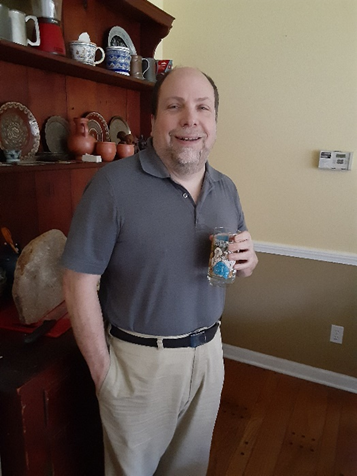
N. Octavius Astronomus came just
a little later. Sibylla escorted Octavius on a short tour of her house, since
he would be staying overnight.
Everyone spent a long time in conversation with others. Cindy, Sibylla’s roommate arrived and participated a bit in conversation as well. Even one of Sibylla’s usually shy cats (the bolder of the two) came by the living room where most people were seated. A spread of snacks brought by the participants, including olives, cheese, and stuffed grape leaves was laid out for enjoyment as we talked.

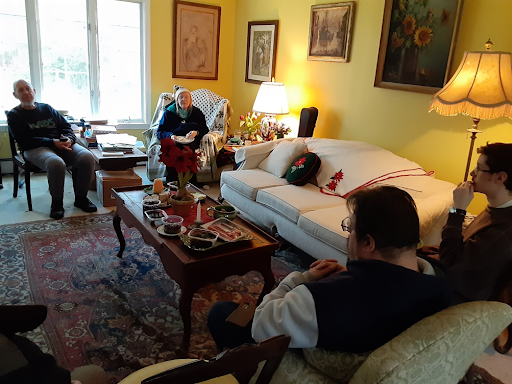


Scholastica reviewed a bit of Latin
vocabulary she had taught her hostess, and shared the names, both Latin &
English, of the numerous birds visible from Sibylla’s back window. I told
Cassius, Vedius, and Octavius about the activities which P. Aurelius Barbatus, the
new governor of America Cismississippiana, had been organizing.
We were so caught up in our
conversations with one another, that we lost track of the activities we had
planned. However, consul Scholastica eventually noted that time was growing
late and called everyone’s attention. We all gathered in the living room, where
Scholastica gave a few opening remarks followed by a short lesson drawn from
Chapter 1 of Conversational Latin for Oral Proficiency by John C.
Traupman.


Figure 1: Scholastica gives a lesson
After the lesson, we had a Zoom
meeting in which we were joined by two friends from abroad, Cn. Cornelius
Lentulus in Hungary & D. Claudius Aquilinus in Germany. This meeting was recorded
and can be seen at https://youtu.be/9cur16B-6PQ.
During the course of that call, I handed out pilei which I had brought. Callidus
had to leave around that time.
After the meeting, Vedius donned
his augural garb and offered a sacrifice of wine and incense to Saturn.


One of
the items included in this ceremony was a Nova Roman banner, which was supplied
by Scholastica and which had been blessed by Lentulus in Rome. Cassius
discussed the issues which made it prohibitively expensive to print high-quality
Nova Roman flags with Octavius and Vedius, suggesting that ordering just one
such flag for the province as a whole would be a good solution.
We then
went to the dining room, where we enjoyed a meal of bread, chicken, stuffing, sausage,
polenta, as well as the remnants of the Roman snacks which we had been enjoying
in the living room. Dessert was cheesecake provided by Quintus.


After
dinner, we took a group photo.
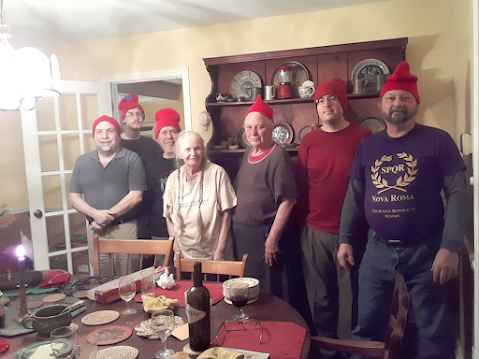
Vedius
had to leave to travel back to New Jersey, so Cassius took this opportunity to
give him, and the rest of us, a set of gifts: a Saturnalia card, a medallion
bearing Nova Roma’s logo, and a Byzantium Novum coin. Vedius showed Cassius the
medallion he was wearing, which Cassius had struck in commemoration of Nova
Roma’s founding years ago. Vedius had found this shortly before the meeting, which
Octavius suggested might be an omen that this was a new beginning for Nova Roma.
After
Vedius departed, we had a presentation from Sibylla about the Roman spice trade.
Sibylla listed specific spices traded from various regions of Asia along with
their uses. A book with maps of these trade routes was passed around for our
consideration. It was also mentioned that silphium plants, previously thought
to have gone extinct during the Roman period, may have been located. In the
living room, Sibylla set up a variety of the spices referenced in her
presentation for us to smell, including nutmeg, long pepper, galangal, mace,
frankincense, and myrrh. A highlight was comparison between cassia (the cinnamon
with which we are more familiar today) and true (Ceylon) cinnamon. Sibylla
provided plastic bags and invited us to take a sampling of spices as a
Saturnalia gift.
Astronomus,
Sibylla, Cassius, and I all signed up to give presentations in 2023. A variety
of topics were suggested by the four of us, and each of us chose one or a few
topics at random.
Cassius,
in his capacity as governor of Nova Britannia, appointed Octavius as Praefectus
Regionis Montis Viridis (organizer and point of contact for Vermont), agreeing
to follow this up with an edict to the same effect on Main List.
Scholastica
gave a presentation on clothing in ancient Greece & Rome. Wearing examples of
each as she described it, Scholastica told us about the Doric peplos,
Attic peplos, and palla; a few examples of men’s clothing were
also included in the presentation. She also had recreations of ancient
jewellery to pass around and gave each attendee a print of a picture she had
drawn herself of a woman wearing a Doric peplos.
Many
thanks to M. Quintius Clavus and Fl. Vedius Germanicus for the beautiful
pictures included in this report. Thanks also to Q. Valerius Callidus, Vedius,
and A. Tullia Scholastica for reviewing this report: any lingering mistakes are
of course my own.
Wednesday, December 23, 2020
Book Review: Saturnalia: A Tale of Wickedness and Redemption in Ancient Rome by Adam Alexander Haviaras
Saturnalia: A Tale of Wickedness and Redemption in Ancient Rome is a fairly straightforward adaption of Charles Dickens' classic A Christmas Carol from Victorian London to Imperial Rome. There will be few surprises here for those who have read the original story or witnessed any of the myriad stage or film versions, but that isn't necessarily a flaw: knowing the eventual outcome of the story can sometimes enhance drama rather than undercut it.
As historical fiction, this novel is a mixed success. The author succeeds in portraying the spirit of the time in question (during the Severan Dynasty), and gets a variety of details right (portraying the diversity of Rome at the time, for instance). There may also be a few minor mistakes. The single most noticeable example is a detail concerning the ritus Graecus given correctly in an earlier chapter and then incorrectly in a later one. There is a glossary of Latin terms in the back which may be helpful to some, particularly as there are a few Latin words used which would normally have been translated (i.e. "cerei" instead of "candles").
As a morality tale, the story is markedly more successful. The author very effectively sets up the greed and callousness of the main character early on (going significantly further than did Dickens: Scrooge was only a serious source of distress to his employees, so far as I can recall, while Catus Pompilius seems at times to be a menace to the entire Eternal City), and his change of heart comes gradually enough to be at least partly believable. One interesting thing about this book is how pious it is: reverence for the gods is repeatedly put hand with generosity, familial affection, enjoyment of life, and the other virtues promoted by the text, and it is the gods themselves who intervene to show the main character the error of his ways.
Overall, this book is worth reading. It may even leave you feeling the urge to practice a bit more kindness and generosity in your own life.
Sunday, December 20, 2020
After Action Report: Remote Saturnalia
Sunday, December 20th, 2020
Participants: Marcus Quintius Clavus (Host)Gaius Claudius Quadratus
Aulus Iulius Paterculus
The meeting started with a few technical difficulties, as I was unable to join the meeting by phone and had to communicate with the other participants by text chat.
Once it had been established that was how the conversation would proceed, the conversation began with a discussion of the activities of Legio III Cyrenaica, which were at that time being shown on Facebook. Quadratus lamented that no such re-enactment groups were active near Montreal, and he an Quintius discussed whether Quadratus might join some of Legio III's activities in his augural garb. Quintius stated that, unlike some other re-enactment groups, Legio III was very open to those who wanted to portray civilian roles, and both confirmed that it would make sense for an augur dressed in his civilian religious garb to accompany a legion, either to take auspices
before battle or to participate in a parade. Quintius mentioned one past event held by Legio III at which a sacrifice to the gods had opened the day's presentations.
Speaking of augury, Quadratus brought up the ongoing conjunction of Saturn with Jupiter, which he held to be a very favourable omen, particularly since its most dramatic manifestation would take place during Saturnalia and the Solstice. He stated that this should be visible on the night of the 21st by looking West just after sunset, and that the two planets should appear to be a single object in the sky, except perhaps to someone using binoculars or who already knew them to be two planets and looked very carefully. Quintius commented that light pollution would likely make this impossible for him to spot, and I concurred, saying that we had been told that the Northern Lights would be visible in the state of Connecticut earlier in the year, but had been foiled in spotting them by all the terrestrial lights. Both Quintius and Quadratus recalled past sightings of the aurora borealis, which for Quadratus had been quite frequent and spectacular, as he had lived even farther North at a time when sunspot activity was at a peak.
Quadratus then redirected the topic to dates, pointing out that many people who should know better - including authors of history books and museum curators - failed to measure the time between B.C. and A.D. dates correctly. Instead of simply adding the dates together, it was necessary to subtract one year to account for the fact that
there was no year zero.
There was a brief discussion of the suggestion to form a study group in the new year. I asked what topic we should study, and it was agreed that a list of proposals should be sent to the forum to see what garnered the most interest.
Quadratus and Quintius then moved on to a discussion of Numismatics. Both were collectors of ancient coins. Quadratus showed off two art pieces he had created with ancient coins in poor condition, while Quintius described a coin in his possession which showed an unidentified emperor, including his upper torso (whereas most coins showed the emperor only from the neck up). Quintius agreed to send a picture of this coin to Quadratus by email for a second opinion. We all speculated on the reasons fewer bronze coins had survived to the modern day from Roman times than silver ones.
This lead to mention by Quintius of the fact that coins containing copper had been located at the site of the Battle of the Teutoburg Forest, and a discussion of the early shifting of blame by several senators near the time of that event from Varus to the common soldiers, something which Quintius blamed partly on the close relationship Varus had with the imperial family.
Shortly thereafter, we all signed off, with a "Io Saturnalia!" from each of us and a resolution to hold another such meeting before too long.
Saturday, December 21, 2019
Solsitium 2772 - December 21st, 2019
Sibylla Ambrosia Fulvia (Hostess)
Marcus Quintius Clavus
Aulus Iulius Paterculus
Cindy (Arrived Later)
Around noon, Sibylla, Quintius, & I met at Sibylla's house. For the first part of the meeting, we sat by the fire discussing Roman topics. On the table in front of us were a number of snacks, including hard-boiled eggs, dried fruit with nuts, bread, and assorted olives.
Quintius presented his collection of Ancient History magazines to us, including issues on Africa, ancient cities, and the Etruscans. He shared the steps which had to be taken to obtain copies, as they are published in Europe, and some of the features which made them such valuable reading. In particular, he pointed out that they do not recycle old artwork, as many publishers do, but instead commission new art to the highest standard of historical accuracy. Sibylla and I were temporarily distracted from the conversation by looking over these beautiful magazines with interest.
Sibylla outlined the progress of her various theses on Mithraism, of which her article for the American Meteor Society in particular had advanced a great deal since we last met and was basically ready for publication. In connection with this topic, I asked two questions: firstly whether we were in touch with the creator of the
mithraism.info website. Secondly, I asked whether the fact that the Mithraic Liturgy had been scribed by a man for his daughter, as I had recently heard, had any bearing on what we should think about the gender-exclusivity of Mithraic rites, as what this document meant overall. Sibylla answered that she had not looked at the Liturgy in
depth, but that other Mithraists used it, including Patti, an attendee of MithraCon. Quintius mentioned a recent post by Patti on Roman Army Talk concerning the Roman Mithras as opposed to the Zoroastrian aspect of the god.
Cindy, a friend and housemate of Sibylla, arrived at the house and joined us by the fire for a time. She opened a discussion on the presentation of the ancient world, as well as medieval times, in film. As it happened, one of the articles in the magazines Quintius had brought turned on this very topic, and we thought over what it had to say as well. Quintius commented on the excellence of the film Alexander, partly due to the creation of new period-appropriate props rather than recycling items from other movies of approximately (meaning "within a thousand
years") the same time period, one of the flaws the article had pointed out in the film it reviewed.
We then went into the dining room for the main meal of the evening. In addition to all the items remaining from the spread by the fire, there was ham provided by Sibylla, and a kind of casserole made of eggs, vegetables, garum, and asafoetida made by Quintius. After that we served a nut tart with honey which I baked the night before. At the table, Sibylla and Quintius discussed events by the Society of Creative Anachronism, particularly a craft contest of which Sibylla was to be a judge. CT State Latin Day was also brought up.
After dinner, Cindy retired for the night and the rest of us returned to our places beside the fire. We discussed ecological depletion in the Roman empire: the extinction of the European lion, of silphium, etc. We also brought up Cato the Younger, on whom there was a bit of disagreement. Quintius argued that he took political obstinacy to an
extreme and was himself partly responsible for the end of the Republic. I found him to be an admirable figure, although perhaps one whom it would be difficult to live with in practice. Both of us recommended the biography Rome's Last Citizen to Sibylla, who was not as familiar with this particular figure.
Saturday, December 22, 2018
After Action Report: Saturnalia 2018
Participants:
Sibylla Ambrosia Fulvia (Hostess)
Marcus Quintius Clavus
Marcus Cassius Julianus
Gaius Claudius Quadratus
Aulus Iulius Paterculus
Phone-in Participant: Jonathan Sibley (Brother of Sibylla)
Quintius and I arrived by car a little after 10 a.m. Along the way, we had been talking about various topics, including the birth narratives of Jesus Christ, Alexander the Great, and Augustus. In this last case, I had argued that there was some plausibility to future greatness being forecast for the son of a prominent Roman, but Quintius pointed out that the Julii had not been one of the leading
families for some time by the time Octavian was born, although acknowledging that they were patricians.
Sibylla welcomed us into her home with coffee and tea; Cassius and Quadratus were already present. I handed out candles, a traditional Saturnalia gift. We sat at the dining room table and discussed, over our hot beverages, research that Quadratus had done some time ago showing that the four Minoan palaces on Crete were aligned to the same midpoint between Crete and the Libyan coast. Quintius commented that modern people still do not give the ancients enough credit for what they were able to figure out; on the other hand, he stated that certain people underestimated the currency of superstition during ancient times. This kicked off a short discussion of superstition in general.
Quadratus gave everyone physical copies of the 2019 edition from his intensively researched Roman calendar. Quintius showed off a 2019 calendar he had created himself on Vistaprint, using art relating to Achilles, Patroclus, and Alexander from DeviantArt (an art sharing website where artists, visual mostly but also written, share their art). The two of them discussed the possibility of adding some of these professional-looking design features to Quadratus’s calendar in the future.
There followed a brief interlude. Quintius began cooking his dish (a savillum/Roman cheesecake) in the kitchen. The rest of us helped set a bedframe back in order, after which Sibylla showed off her home library and Cassius discussed with Quadratus the minting of new Roman-style coins.
We then retired to the living room for a while. Sibylla lit the hearth, using a Cape Cod lighter. I did a short presentation on the women of early Rome (women who appeared in Livy’s Ab Urbe Condita from Lavinia to Lucretia). Quadratus asked about other notable women from the end of this time to Cornelia mother of the Gracchi. I mentioned Cloelia, who was given as a hostage to the Etruscan king Lars Porsenna and managed to escape, winning such respect from the king in the
process that he voluntarily released half his captives. Since Cloelia is a gens name, we checked on the Album Civium to see whether there were any Cloelii in Nova Roma - there were not, although it was an option on the list of gentes. (Future citizens take note - you could be the first to take up this famous name, present on the Senate rolls since the conquest of Alba Longa!)
There followed a discussion of activities that we could undertake in the coming year. We considered the proposal for a volunteerism-oriented event which had been raised online. Cassius
argued that many groups were too quick to embrace causes other than their own, leaving no one to defend their original mission. However, he did speak in favor of activity which had both a Roman and charitable dimension. Quadratus mentioned the assistance of homeless veterans as one that we might adopt. The overall consensus was in favor, but that the details still needed work.
We returned to the dining room for the feast. We lit one of the small candles before each of us and one of the two tapers in the middle of the table at the start of the meal. Statues of the Leontocephalus and either Bacchus (with grapes held high) or Attis (judging from his garb) were placed at the head of the table; Cassius said a short grace. Sibylla had prepared roast rabbit with mushrooms in a cream sauce. Quintius had brought pesto parmesan bread and fine Greek wine. We also had olives, olive bread, and stuffed grape leaves.
After the main part of lunch we had dessert: globuli (balls of curd cheese fried and rolled in honey) which I had made, as well as the savillum made by Quintius, fresh from the oven. The savillum was quite different from the version we had eaten on a prior occasion (although at least as good); its texture was soft, almost like a bread pudding, its flavor was extremely sweet, and it was topped with poppy seeds which added an interesting variation to both.
Sibylla laid a collection of ancient artifacts which she had purchased on the table for display.
Still at the table, Quintius gave a presentation on the various confrontations between the Roman army and Macedonian-style phalanxes, running from the Pyrrhic War to the defeat of Perseus. In addition to describing the equipment and fighting style of the Macedonians, Quintius outlined some of the history of the wars involved and developments in the Roman army itself, particularly the cavalry. Sibylla shared some illustrations of Roman cavalry running down enemy
soldiers just as Quintius described and Quadratus told us that this was a common motif on coins beginning with Constantius II.
Sibylla’s brother Jonathan, who is very knowledgeable about pipe organs, and owns a 3 manual Wurlitzer, called in and shared with us a fact about pipe organs (also known as hydrauli): that they had been banned in Calvinist England because organ music had accompanied the execution of Christians in the arena. This started a conversation about music both ancient and modern, to which Cassius contributed by finding the music of a reconstructed Roman organ on the internet.
We had another discussion about organizational issues. Planning for the tasks ahead of us naturally lead to thoughts of the extremely valued member lost this year, Marcus Minucius Audens (James Matthews), who would have been the first to pitch in had he still been present.
We paused to dedicate a toast to him.
The continuing planning session took a lively turn when a list of citizens, which Quadratus had out to note information for Quintius, caught fire. Quadratus assured us that any ill omen involved was nullified by the very positive omen that we had all survived.
We ended the night by playing the free printable version of Card-Tamen, a game invented by Classicists as an educational tool. In keeping with the holiday, we worked out a method of playing for chocolate coins.
After Action Report drafted by A. Iulius Paterculus, with additions and corrections by Sibylla Ambrosia Fulvia and Marcus Quintius Clavus
Sunday, January 14, 2018
Photos of Bread Making from Saturnalia 2017 Meeting


