Saturday, December 17, 2022

Saturnalia 2775 - December 17th, 2022


Attendees: Sibylla Ambrosia Fulvia (Hostess)

Marcus Quintius Clavus

Aula Tullia Scholastica

Flavius Vedius Germanicus

Aulus Iulius Paterculus

Quintus Valerius Callidus

Marcus Cassius Iulianus

Numerius Octavius Astronomus

Cindy

                Fl. Vedius Germanicus and I arrived at the house of Sibylla Ambrosia Fulvia’s house around noon. M. Quintius Clavus and A. Tullia Scholastica had already arrived. Sibylla offered coffee and tea to her guests; Quintius was having an herbal blend which happened only to contain ingredients known to the Romans.


We started to converse on various topics, and more people joined gradually. Q. Valerius Callidus was next to arrive. “Finally, an event!” he said cheerily as he walked through the door. I pointed out that there had been a small gathering at Sibylla’s house in March of that year, but he had not heard about it at the time.

Vedius and Callidus discovered an extraordinary coincidence – the two of them had actually grown up in the same town at the same time, and knew many of the same people, even though they didn’t remember meeting each other before.

M. Cassius Julianus followed soon after. He had brought a few trays of antiquities which some other members of the group helped to carry into the house.



N. Octavius Astronomus came just a little later. Sibylla escorted Octavius on a short tour of her house, since he would be staying overnight.

Everyone spent a long time in conversation with others. Cindy, Sibylla’s roommate arrived and participated a bit in conversation as well. Even one of Sibylla’s usually shy cats (the bolder of the two) came by the living room where most people were seated. A spread of snacks brought by the participants, including olives, cheese, and stuffed grape leaves was laid out for enjoyment as we talked.

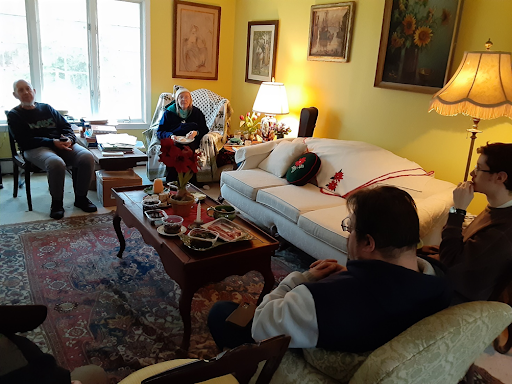


Scholastica reviewed a bit of Latin vocabulary she had taught her hostess, and shared the names, both Latin & English, of the numerous birds visible from Sibylla’s back window. I told Cassius, Vedius, and Octavius about the activities which P. Aurelius Barbatus, the new governor of America Cismississippiana, had been organizing.

We were so caught up in our conversations with one another, that we lost track of the activities we had planned. However, consul Scholastica eventually noted that time was growing late and called everyone’s attention. We all gathered in the living room, where Scholastica gave a few opening remarks followed by a short lesson drawn from Chapter 1 of Conversational Latin for Oral Proficiency by John C. Traupman.


Figure 1: Scholastica gives a lesson

After the lesson, we had a Zoom meeting in which we were joined by two friends from abroad, Cn. Cornelius Lentulus in Hungary & D. Claudius Aquilinus in Germany. This meeting was recorded and can be seen at https://youtu.be/9cur16B-6PQ. During the course of that call, I handed out pilei which I had brought. Callidus had to leave around that time.

After the meeting, Vedius donned his augural garb and offered a sacrifice of wine and incense to Saturn.


                One of the items included in this ceremony was a Nova Roman banner, which was supplied by Scholastica and which had been blessed by Lentulus in Rome. Cassius discussed the issues which made it prohibitively expensive to print high-quality Nova Roman flags with Octavius and Vedius, suggesting that ordering just one such flag for the province as a whole would be a good solution.

                We then went to the dining room, where we enjoyed a meal of bread, chicken, stuffing, sausage, polenta, as well as the remnants of the Roman snacks which we had been enjoying in the living room. Dessert was cheesecake provided by Quintus.


                After dinner, we took a group photo.
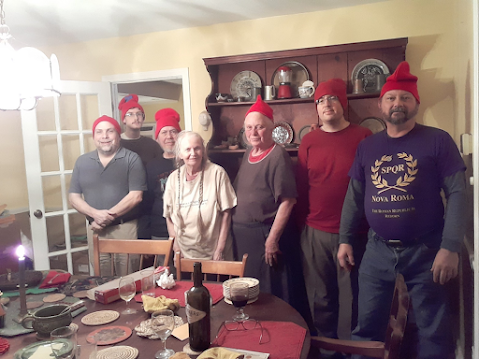

                Vedius had to leave to travel back to New Jersey, so Cassius took this opportunity to give him, and the rest of us, a set of gifts: a Saturnalia card, a medallion bearing Nova Roma’s logo, and a Byzantium Novum coin. Vedius showed Cassius the medallion he was wearing, which Cassius had struck in commemoration of Nova Roma’s founding years ago. Vedius had found this shortly before the meeting, which Octavius suggested might be an omen that this was a new beginning for Nova Roma.

                After Vedius departed, we had a presentation from Sibylla about the Roman spice trade. Sibylla listed specific spices traded from various regions of Asia along with their uses. A book with maps of these trade routes was passed around for our consideration. It was also mentioned that silphium plants, previously thought to have gone extinct during the Roman period, may have been located. In the living room, Sibylla set up a variety of the spices referenced in her presentation for us to smell, including nutmeg, long pepper, galangal, mace, frankincense, and myrrh. A highlight was comparison between cassia (the cinnamon with which we are more familiar today) and true (Ceylon) cinnamon. Sibylla provided plastic bags and invited us to take a sampling of spices as a Saturnalia gift.

                Astronomus, Sibylla, Cassius, and I all signed up to give presentations in 2023. A variety of topics were suggested by the four of us, and each of us chose one or a few topics at random.

                Cassius, in his capacity as governor of Nova Britannia, appointed Octavius as Praefectus Regionis Montis Viridis (organizer and point of contact for Vermont), agreeing to follow this up with an edict to the same effect on Main List.

                Scholastica gave a presentation on clothing in ancient Greece & Rome. Wearing examples of each as she described it, Scholastica told us about the Doric peplos, Attic peplos, and palla; a few examples of men’s clothing were also included in the presentation. She also had recreations of ancient jewellery to pass around and gave each attendee a print of a picture she had drawn herself of a woman wearing a Doric peplos.

                Many thanks to M. Quintius Clavus and Fl. Vedius Germanicus for the beautiful pictures included in this report. Thanks also to Q. Valerius Callidus, Vedius, and A. Tullia Scholastica for reviewing this report: any lingering mistakes are of course my own.


Friday, November 18, 2022

New Leadership in Nova Britannia!

    Marcus Cassius Julianus, co-founder of Nova Roma, has been officially appointed as proconsul of the united province of Nova Britannia.

   Knowledge of past efforts by Cassius and the strong support of other active citizens in the province inspire confidence that this administration will be a successful one! 

Saturday, August 13, 2022

Comic Review: Iphigenia in Aulis: The Age of Bronze Edition

     This book features an original translation by playwright and author Edward Einhorn of the classic play by Euripedes, accompanied by high-quality black-and-white illustrations by Eric Shanower.

    The play itself is moving and certainly worth reading, although this is likely as true of other translations as of this particular one. The opening scenes are not quite as engaging as those later in the text: it's only once characters with different agendas begin engaging in dialog that the strengths of the author are truly evident. Iphigenia's final speech is particularly effective, but at the same time sounds what feel like at least a few false notes to the modern audience member, which are discussed briefly in an appendix.

    The illustrations are not so frequent as to overwhelm the text but complement it well by allowing one to read the facial expressions of the characters, much as one might in a dramatic rendering. (Of course, this wouldn't be the case in a traditional tragic performance of the play, in which the actors are masked. Somewhat ironically, the supplementary text reveals that this was the path the director took when staging this translation, meaning that viewers would have experienced the work very differently from readers despite the common text.)

    There are a few appendices with details of the stage production and thoughts on the text, as well as a glossary and family tree. These endnotes should probably be taken critically. In particular, the suggestion in the director's notes that 'the mob' is the true antagonist in the play seems dubious to me: I am half inclined to take the (always offstage) protests of the soldiers as merely an excuse for the male characters onstage to act according to their preexisting inclinations. Additionally, I believe that the glossing of "Centaurs" is simply mistaken: modern scholars have hypothesised that centaurs were inspired by horse-riding cultures who interacted with the early Greeks, but within Greek myth itself they were clearly human-horse hybrids.

Wednesday, January 19, 2022

For the Divine Emperors

When British flags over fair India flew

and an old viceroy demitted to a new, 

the old was honoured for the the service past

with a new title higher than the last.

Just so, it's right that each imperial ghost 

retires to an even higher post

thenceforth receiving honours divine

once the Senate hears the proper sign.

For think what years of toil and pain

make a successful emperor's reign:

to start, you very often need 

to win a civil war ere you accede.

For that, you need to win your legions' love 

to have the favour of the gods above,

and strain your mind for fruitful strategy.

Thereafter calls for still more energy,

for having passed your initial test

you may have little chance to rest.

Soon you could be called to the frontier

where the barbarians draw near,

or else the soldiers want more pay

and willfully revolt to get their way.

The cities are too prone to riot:

free bread must be their steady diet.

Games and gifts you ought to share,

not just in Rome but everywhere.

So your largesse will not be lax,

you'll need to bring in loot or tax,

and while fiscal facts are faced -

take care the coins are not debased!

Your relatives will likely plot

to take themselves all that you've got.

With such chores, if, when you leave,

all the Roman people grieve 

for one who gave them more

than all the strengths they had before,

if you have that skill and nerve

perhaps you thoroughly deserve

your space in many a humble shrine.

Monday, October 11, 2021

After Action Report: September 2021 Remote Nova Britannia Chat

 September 27th, 2021, 7:00 p.m. – 8:00 p.m.

Participants: C. Claudius Quadratus

                     A. Tullia Scholastica

                     A. Iulius Paterculus (Host)

 Quadratus was the first to join the meeting an opened our discussion of Roman topics by mentioning that he had just started to re-read The First Man in Rome, as he tends to do once every ten years.

Quadratus also said that he was hoping to travel to Rome, but that there had been flight delays, which was not a good sign. In Rome itself, he had heard there were riots over Green Passes (the vaccine passport system in Italy).

We talked a little about the essay contest which had concluded the recent Ludi Romani. I agreed with Quadratus that the upper wordcount for these essays should probably have been higher and stated that I had hoped sharing the essays would have sparked some conversation on the Main List.

For instance, I said, I was strongly in agreement with the argument Quadratus had made in his essay that modern politicians should observe term restrictions as they had during the Roman Republic. I particularly thought that politicians should not have the ability to run for successive terms, since it resulted in time wasted in campaigning when they should be doing their jobs. Quadratus stated that the elections in Canada occurred with roughly five weeks’ notice, which reduced this problem somewhat. He also suggested a maximum age limit for politicians. I argued that if he was concerned about their mental state, it would be better to give competency exams and that the younger cohort probably would benefit by such screening just as much.

                Scholastica joined the call. She informed us that her Latin classes were very busy, as there were only two teachers in place of three. Scholastica also said that this particular group of students was more diverse than average, with students from Hong Kong, Spain, Brazil, Argentina, South Africa, Dar es Salaam, Wuhan, Iran, Italy, & the United States. Despite this, one student had such limited exposure to other cultures as to complain that the Spring and Winter breaks were not named after Easter and Christmas, which “everyone” celebrated, but Quinquatria and Saturnalia, which “no one” did.

                 Quadratus filled Scholastica in on his plans to re-read Colleen McCullough’s series. We all appreciated her work, Scholastica commenting that it had been comforting reading during a time of illness and was also handy for lifting as a weight! Quadratus said that the 100 page glossary in the back taught him more than a college class. I asked them what they thought of McCullough’s other work, saying I’d enjoyed The Thorn Birds but not The Independence of Miss Mary Bennet. Quadratus said that he hadn’t liked the other series of hers he had once started.

                Quadratus mentioned adopting a shy cat named “Biden” from the shelter. The shelter had named it and registered that name with the authorities when it was microchipped.  Friends and relatives of Quadratus, knowing his political bent, found it very funny.  Biden was a very nice cat and slowly getting used to his new surroundings.

                Quadratus stated that he was pausing his plans for a numismatic sodalitas, since there didn’t seem to be enough interest. Scholastica answered that there had not been much activity in the sodalitates in general, although one new member had joined Musarum the preceding day. I said that this could well be a friend to whom I had recommended the group.

                I said that building the sodalitates would take much time and effort, including a number of posts to encourage others to join in the conversation. I also said that it would be nice to have a sodalitas devoted to philosophy, and that it was rather surprising we didn’t already have one.

                Scholastica said we already had one, albeit an unofficial one, headed by Cassius.  She added that there was not much interest in the subject, quoting a similar observation by the satirist Juvenal. I disagreed, citing the ongoing Stoic renaissance, including multiple in-person groups in Connecticut in recent years and, within Nova Roma, a citizen who used to blog passages from Seneca. Scholastica recalled similar posts on the Main List once, but no longer.

                Scholastica said that that she and Gnaeus Cornelius Lentulus had different approaches to contacting prospective members. Scholastica added that the probationary period and citizenship test had been reinstated effective September 1st.

                Quadratus questioned whether these restrictions would really benefit recruitment, but Scholastica countered that many people applied for citizenship for reasons other than a love of Rome, such as an ambition to immigrate to the land we once owned in Texas.

                The discussion turned to animal sacrifice: Scholastica said that the thought of killing an animal to please a deity disturbed her, even if said animal was also eaten, but also that it didn’t much affect her since she was not a cultrix. Quadratus said that this practice was a deal-breaker for him, and that he had banned it is his province of Canada. I was in favour of animal sacrifice, and stated that if an animal was to be slaughtered anyway, having an additional purpose in doing so couldn’t do any harm, even if one didn’t credit the intended benefit. However, my main emphasis was the hope that cultores who did and did not engage in this practice could tolerate one another without denigrating or trying to stop one another’s acts of worship.

                Quadratus brought up that the U.S./Canada was still sealed for quarantine. This brought up discussion of the Antonine Plague and the plague of Athens. Scholastica pointed out that the plague of Athens was aggravated by Spartans whose siege crowded Athenians into their city and who tossed bodies over the walls. Quadratus also recalled food shortages which contributed to vulnerability to disease. I expressed surprise that catapults had already been invented in Classical Greece.

                I asked whether there was much activity in Canada or Mediatlantica. Quadratus said there was none in Canada, as he had little interest from local citizens and was happier to attend than organize in any case – though in-person was better than virtual.

                I asked whether they might come down to Connecticut. Quadratus confirmed that he would, possibly as soon a November. Scholastica said that she could not engage in such long-term driving at present, due to recent injuries.

Sunday, August 29, 2021

After Action Report: August 2021 Remote Nova Britannia Chat

August 23, 2021, 5:00 p.m. - 6:00 p.m.

Participants: Gaius Claudius Quadratus
                       Aula Tullia Scholastica
                       Aulus Iulius Paterculus (Host)
   Once everyone had convened, there was some small talk, particularly about Hurricane Henri, which we suspected of having prevented at least,one additional person from joining us.
   Quadratus started off the Roman discussion with a review of the Arx Mercatura online store. He warned that the goods which they sold took an unreasonably long time to arrive, and in some cases were not even fabricated until they had been sold. He did say that the finished items were of fine quality, however, and showed us an acerra and lararium he had purchased from them in the past.
   Scholastica reported on the status of the election for Nova Roma's Board of Directors. She also reported having received an update on the castrum project undertaken by D. Marcius Vulpes in Maine.
   I asked whether anyone had recently done any interesting research. Quadratus answered that, while he had not recently done much research on Rome, he had done some on World War II. Quadratus summarized an insight or two from this reading, including the conclusion that most Germans were aware of the extent of Nazi atrocities before the end of the war.
   Scholastica stated that two sodalitates were up and running, while another two waited only for new pictures to be added to their front pages. Quadratus asked what would be necessary to form a Sodalitas Numismaticae - Scholastica referred him to the Lex Cassia de creatione sodalitatumbut summarized that a set of internal rules and a method of selecting leaders was needed.
   Scholastica commented on the fact that Quadratus had been instructed to learn a set of Latin texts as part of his augural duties, and offered help in studying if needed. Quadratus stated that his Latin skills should be up to the task, as he had translated the Res Gestae alone, but that he was still waiting to receive the texts in question.

Monday, June 21, 2021

A Hymn to Sol

Sol, Sol, Sol Indiges,
though nightly you concede
the world to holy darkness
Each morning you advance
once more past the horizon:
renewed and never conquered.

From your vantage point far at the apex
shadows shrink from sight
as your gaze illuminates
all that the skies cover.

You take the middle path,
though steering unruly horses,
not veering to cold distance
nor fiery closeness,
and daily you retreat
at just the proper time:
(clocks are set by you).

But each morning you advance
once more past the horizon:
renewed and never conquered.
Sol Indiges, Sol, Sol.