For anyone who would like to sign up for Nova Britannia's email list, M. Cassius Julianus has created a new version of this list (due in part to changes to Yahoo Groups) at https://groups.io/g/NovaBritanniaProvincia/.
If you find the information on this blog helpful, then you are likely to find membership in our weblist even more so, as the same events advertised here are discussed there as they are being planned. Members can share their own ideas for activities to be taken here in New England and any interesting facts about Rome about which they happen to learn.
Sunday, November 10, 2019

Saturday, October 5, 2019
Rome's Last Citizen: The Life and Legacy of Cato, Mortal Enemy of Caesar by Rob Goodman and Jimmy Soni
This book aims to be both a biography of Cato the Younger and an analysis of the impact the legend which followed him had on later generations. Both journalists, the authors seem particularly attuned to politics, and convincingly dissect both the political strategies which Cato himself employed and the use to which he was put by such worthies as George Washington. Occasionally, their search for parallels between ancient Roman politics and those of modern times may go too far, as when they refer to the populares as occupying the "left" of the Roman political scene (a characterization which has a touch of truth, but could lead a careless reader to import too many assumptions).
More often, particularly during the more purely biographical section which takes all but the Prologue and Epilogue of the book, this strategic reading of the conflicts between the factions of the Late Republic provides a quiet sub-current to the essentially character-based narrative which the authors drew from the work of numerous ancient writers. Cato's great strength and weakness, the authors let us see repeatedly, was that he demanded personal virtue triumph while viewing often viewing mere strategy with contempt. The authors are often critical of this approach, but reveal and explain the partial successes that resulted from it. In some ways, the type of politician who succeeds is a reflection of the people who vote him, or her, into power; Goodman & Soni do not neglect the strands of Roman thought which Cato came to symbolize and why others often chose to support him, even at the expense of their own interests.
In the foreground to all of this was a life of self-imposed hardship: not so much the famed austerity, though that is mentioned as well, but relationships personal and political strained because of an unwillingness to compromise and an encroaching melancholy as the Republic careened from one looming threat to another yet more serious. There is powerful writing in many places, as the authors depict the frustration Cato must have felt when his warnings were unheard and his efforts to preserve libertas seemed doomed. At other points, there are glimpses of success, even happiness. We also see a certain evolution in Cato's thought and action over time, which remains opaque despite the authors' attempts to interpret it: as his goals seemed more remote in the pragmatic Roman present, Cato seems to have embraced both the antique Roman model and a universalizing Stoicism with increasing fervour. At last, these two pillars of his existence seemed to fuse together, so that Rome was synonymous with virtue and freedom.
This book deserves the greatest praise it can be given: that it does justice to its subject. I recommend it to everyone, particularly those who would like to think over the essence of the Roman Republic. Although Cato's is not the only perspective of value, I don't think we can fully understand that ideal without giving due weight to his vision, as they were expressed in his words and deeds.
More often, particularly during the more purely biographical section which takes all but the Prologue and Epilogue of the book, this strategic reading of the conflicts between the factions of the Late Republic provides a quiet sub-current to the essentially character-based narrative which the authors drew from the work of numerous ancient writers. Cato's great strength and weakness, the authors let us see repeatedly, was that he demanded personal virtue triumph while viewing often viewing mere strategy with contempt. The authors are often critical of this approach, but reveal and explain the partial successes that resulted from it. In some ways, the type of politician who succeeds is a reflection of the people who vote him, or her, into power; Goodman & Soni do not neglect the strands of Roman thought which Cato came to symbolize and why others often chose to support him, even at the expense of their own interests.
In the foreground to all of this was a life of self-imposed hardship: not so much the famed austerity, though that is mentioned as well, but relationships personal and political strained because of an unwillingness to compromise and an encroaching melancholy as the Republic careened from one looming threat to another yet more serious. There is powerful writing in many places, as the authors depict the frustration Cato must have felt when his warnings were unheard and his efforts to preserve libertas seemed doomed. At other points, there are glimpses of success, even happiness. We also see a certain evolution in Cato's thought and action over time, which remains opaque despite the authors' attempts to interpret it: as his goals seemed more remote in the pragmatic Roman present, Cato seems to have embraced both the antique Roman model and a universalizing Stoicism with increasing fervour. At last, these two pillars of his existence seemed to fuse together, so that Rome was synonymous with virtue and freedom.
This book deserves the greatest praise it can be given: that it does justice to its subject. I recommend it to everyone, particularly those who would like to think over the essence of the Roman Republic. Although Cato's is not the only perspective of value, I don't think we can fully understand that ideal without giving due weight to his vision, as they were expressed in his words and deeds.
Book Review: Dreaming the Eagle: A Novel of Boudica, The Warrior Queen by Manda Scott
This book treats us to two parallel Bildungsromans: the comming of age of the warrior Breaca, including how she came to be known by the title Boudica ("She Who Brings Victory", the authoress translates for us) and that of her fictional brother Bán. Over the course of their initiations into their very different roles as adults, we see first something of contemporary British Celtic society as Scott imagines it & gradually increasing signs of the past & future conflict between the Celts & Romans.
This book occupies a place somewhere between historical fiction & fantasy in terms of genre. Although there is no point at which the tale deviates from known history (so far as I could tell), little enough is known of Boudica's life & the society into which she was born that much is authorial invention by necessity, and some of that invention was slightly mystical, particularly those which take place on the island of Mona. These elements were well integrated into the story as a whole, and suspending disbelief while reading was easy. In retrospect, it seems that the culture of the British tribes are a little too tailored to modern sensibilities to be fully plausible (no slavery & a great deal of concern for animal welfare; the full equality of the sexes is somewhat believable, since Boudica was, after all, a real person).
It takes time to understand the characters, but we get a chance to see the virtues & flaws of each, with the exception of a few wholly villianous characters. Scott is similarly nuanced in her depictions of the two cultures on display: despite the fact that the Romans are antagonistic to her heroine, Scott never adopts the same hostility towards them as many of her more sympathetic characters. A noble Roman is introduced fairly early in the story, apparently to dispel any inclination of readers to view the Empire as a conquest-hungry monolith, although it soon becomes clear that he also has a significant role in the plot.
Certain scenes portray the abuse of slaves, which many people may find painful to read , but they clearly have a justification in terms of character development: they are not gratuitous.
Overall, this is an excellent book - probably not the best for learning about the culture of the Celts as it actually existed, but great entertainment, and possibly a good starting point to develop an interest in this corner of the empire.
Sunday, April 14, 2019
After Action Report: MithraCon 2019
Friday, April 12th, 2019
Participants:
Sibylla Ambrosia Fulvia (Hostess)
Marcus Quintius Clavus
Marcus Cassius Julianus
Mercuria Cassia
Ed
Wenna
Aulus Iulius Paterculus
Quintius & I arrived to find Sibylla, Cassius, and Mercuria already in the room and deep in discussion.
We left for dinner almost immediately. The Afghani restaurant where we had eaten the previous year had closed, so we ate the "Basil" restaurant (a Thai/Chinese/Japanese fusion establishment) next door instead. Cassius passed out laminated fact sheets on the interactions between Rome and China in antiquity, which we read in appreciative silence. Soon after our orders arrived, Ed and Wenna joined the group.
There was some disscussion on general topics, MithraCons past, and what restaurant we might visit next year, but much of our attention was occupied by the food in front of us, which were in generous portions accompanied by pots of tea for the table. Reactions on the food itself varied.
After dinner, Ed and Wenna said their farewells and the rest of us returned to the room to engage in further conversation. Sibylla shared insights gained from another year's reasearch into Mithraism. Cassius contributed more insights from his Masonic experience; Mercuria fact-checked information online, discovering some additional details, of which even Cassius had not been aware.
Sibylla mentioned the recent reintroduction of the priesthood training by Cn. Lentulus and the possibility that Sibylla might organize an official Mithraic cult to be recognized by Nova Roma.
Cassius caught us up with some of the progress made by Byzantium Novum over the previous year.
Cassius also presented us with T-shirts which had been made at his copy shop, which showed a beautiful image of the Rockbirth of Mithras.
Saturday, April 13th, 2019
Additional Participants:
Alex
Adam
The following day we enjoyed the now traditional breakfast at Patricia’s, the diner less than a block from the hotel. Mercuria was sadly not able to join us at breakfast due to headache, but later arrived at the Sterling library for a day of intense research. When the library finally closed, we exited to find a group of students practicing improv of the steps ahead of the library entrance.
Afterwards, we split into two groups, head to the Yale Barnes & Nobles and the hotel. We re-united in an hour or two in the hotel room over a feast including stuffed grape leaves, fruit, bread, chicken, lettuce, and large quantities of cheese, followed by raspberry and apple tarts brought down from Maine. Our discussion touched on a number of topics including the modern U.S. navy, before turning to the research we had done in the library during the day. Sibylla had a long list on Mithraism which she had ordered to Sterling in advance. Cassius told us about two particular books he had recently purchased, Pictish Mithraism, which postulated a link between Pictish carved
standing stones and Mithraism and The Trail of Mithras which examined a supposed line of Mithraea running
across the Roman Empire and the churches later built above some of them. I had read selections from books on various topics, including the infinity problem in quantum physics, the lives of Laura Ingalls
and Rose Wilder, the novels of Steven King, and Greek tragedy.
Alex & Adam arrived partway through our discussion of library research. Conversation turned to how Alex had
come to join us: as it turned out, he had been entranced by the Mithraeum when he began working as at the Yale Art Gallery and been told by a fellow employee about the conference which visited each year. We discussed Mithraism for some time after that; in particular details of initiation which it appeared could be deduced from the
mosaic and frescos at the Felicissima Mithraeum and the "Mithraic liturgy".
Sunday, April 14th, 2018
We returned for Patricia's for a second excellent breakfast, this time with Mercuria as part of the group. Quintius was not with us, as he had returned home the previous night. Discussion turned mainly upon life in New England and personal interests, including research into runes by both Mercuria and Sibylla.
On our way to the art gallery, we passed an interesting used bookstore, but although the sign said "Open", it was actually closed. Someone joked that on the way back the sign would say "Closed", but the store would be open.
We arrived at the gallery somewhat early, and hence had time to tour not only the Classical wing of the gallery but a section devoted to coins of assorted eras and another devoted to Byzantine art. Alex soon joined us at looking over the items in the Classical wing, and particularly the Dura Europe exhibit. This exhibit had been somewhat
diminished, as certain items were on loan elsewhere, but the Mithraeum was still intact. Sibylla spoke about the items before us both with Alex and with some other patrons of the gallery. After a little while, Cassius and Mercuria left, followed soon after by Alex. Quintius joined Sibylla and me shortly afterwards. We had coffee & tea together, followed by a visit to the bookstore we had passed earlier, which was indeed open and had an adequate collection of Classics-related books.
Participants:
Sibylla Ambrosia Fulvia (Hostess)
Marcus Quintius Clavus
Marcus Cassius Julianus
Mercuria Cassia
Ed
Wenna
Aulus Iulius Paterculus
Quintius & I arrived to find Sibylla, Cassius, and Mercuria already in the room and deep in discussion.
We left for dinner almost immediately. The Afghani restaurant where we had eaten the previous year had closed, so we ate the "Basil" restaurant (a Thai/Chinese/Japanese fusion establishment) next door instead. Cassius passed out laminated fact sheets on the interactions between Rome and China in antiquity, which we read in appreciative silence. Soon after our orders arrived, Ed and Wenna joined the group.
There was some disscussion on general topics, MithraCons past, and what restaurant we might visit next year, but much of our attention was occupied by the food in front of us, which were in generous portions accompanied by pots of tea for the table. Reactions on the food itself varied.
After dinner, Ed and Wenna said their farewells and the rest of us returned to the room to engage in further conversation. Sibylla shared insights gained from another year's reasearch into Mithraism. Cassius contributed more insights from his Masonic experience; Mercuria fact-checked information online, discovering some additional details, of which even Cassius had not been aware.
Sibylla mentioned the recent reintroduction of the priesthood training by Cn. Lentulus and the possibility that Sibylla might organize an official Mithraic cult to be recognized by Nova Roma.
Cassius caught us up with some of the progress made by Byzantium Novum over the previous year.
Cassius also presented us with T-shirts which had been made at his copy shop, which showed a beautiful image of the Rockbirth of Mithras.
Saturday, April 13th, 2019
Additional Participants:
Alex
Adam
The following day we enjoyed the now traditional breakfast at Patricia’s, the diner less than a block from the hotel. Mercuria was sadly not able to join us at breakfast due to headache, but later arrived at the Sterling library for a day of intense research. When the library finally closed, we exited to find a group of students practicing improv of the steps ahead of the library entrance.
Afterwards, we split into two groups, head to the Yale Barnes & Nobles and the hotel. We re-united in an hour or two in the hotel room over a feast including stuffed grape leaves, fruit, bread, chicken, lettuce, and large quantities of cheese, followed by raspberry and apple tarts brought down from Maine. Our discussion touched on a number of topics including the modern U.S. navy, before turning to the research we had done in the library during the day. Sibylla had a long list on Mithraism which she had ordered to Sterling in advance. Cassius told us about two particular books he had recently purchased, Pictish Mithraism, which postulated a link between Pictish carved
standing stones and Mithraism and The Trail of Mithras which examined a supposed line of Mithraea running
across the Roman Empire and the churches later built above some of them. I had read selections from books on various topics, including the infinity problem in quantum physics, the lives of Laura Ingalls
and Rose Wilder, the novels of Steven King, and Greek tragedy.
Alex & Adam arrived partway through our discussion of library research. Conversation turned to how Alex had
come to join us: as it turned out, he had been entranced by the Mithraeum when he began working as at the Yale Art Gallery and been told by a fellow employee about the conference which visited each year. We discussed Mithraism for some time after that; in particular details of initiation which it appeared could be deduced from the
mosaic and frescos at the Felicissima Mithraeum and the "Mithraic liturgy".
Sunday, April 14th, 2018
We returned for Patricia's for a second excellent breakfast, this time with Mercuria as part of the group. Quintius was not with us, as he had returned home the previous night. Discussion turned mainly upon life in New England and personal interests, including research into runes by both Mercuria and Sibylla.
On our way to the art gallery, we passed an interesting used bookstore, but although the sign said "Open", it was actually closed. Someone joked that on the way back the sign would say "Closed", but the store would be open.
We arrived at the gallery somewhat early, and hence had time to tour not only the Classical wing of the gallery but a section devoted to coins of assorted eras and another devoted to Byzantine art. Alex soon joined us at looking over the items in the Classical wing, and particularly the Dura Europe exhibit. This exhibit had been somewhat
diminished, as certain items were on loan elsewhere, but the Mithraeum was still intact. Sibylla spoke about the items before us both with Alex and with some other patrons of the gallery. After a little while, Cassius and Mercuria left, followed soon after by Alex. Quintius joined Sibylla and me shortly afterwards. We had coffee & tea together, followed by a visit to the bookstore we had passed earlier, which was indeed open and had an adequate collection of Classics-related books.
Saturday, February 2, 2019
Origin of the Nova Britannia Flag
Apparently, one of the official flags of New England is a red flag with a pine tree on a white field in one corner.
 This flag, called the "Bunker Hill Flag" is clearly the inspiration behind our own Nova Britannia flag.
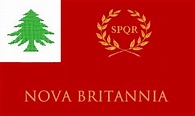 Marcus Audens must have used his extensive knowledge of the American Revolution when designing our local emblem - an interesting and appropriate connection.
Saturday, December 22, 2018
After Action Report: Saturnalia 2018
Saturday, December 22nd, 2018
Participants:
Sibylla Ambrosia Fulvia (Hostess)
Marcus Quintius Clavus
Marcus Cassius Julianus
Gaius Claudius Quadratus
Aulus Iulius Paterculus
Phone-in Participant: Jonathan Sibley (Brother of Sibylla)
Quintius and I arrived by car a little after 10 a.m. Along the way, we had been talking about various topics, including the birth narratives of Jesus Christ, Alexander the Great, and Augustus. In this last case, I had argued that there was some plausibility to future greatness being forecast for the son of a prominent Roman, but Quintius pointed out that the Julii had not been one of the leading
families for some time by the time Octavian was born, although acknowledging that they were patricians.
Sibylla welcomed us into her home with coffee and tea; Cassius and Quadratus were already present. I handed out candles, a traditional Saturnalia gift. We sat at the dining room table and discussed, over our hot beverages, research that Quadratus had done some time ago showing that the four Minoan palaces on Crete were aligned to the same midpoint between Crete and the Libyan coast. Quintius commented that modern people still do not give the ancients enough credit for what they were able to figure out; on the other hand, he stated that certain people underestimated the currency of superstition during ancient times. This kicked off a short discussion of superstition in general.
Quadratus gave everyone physical copies of the 2019 edition from his intensively researched Roman calendar. Quintius showed off a 2019 calendar he had created himself on Vistaprint, using art relating to Achilles, Patroclus, and Alexander from DeviantArt (an art sharing website where artists, visual mostly but also written, share their art). The two of them discussed the possibility of adding some of these professional-looking design features to Quadratus’s calendar in the future.
There followed a brief interlude. Quintius began cooking his dish (a savillum/Roman cheesecake) in the kitchen. The rest of us helped set a bedframe back in order, after which Sibylla showed off her home library and Cassius discussed with Quadratus the minting of new Roman-style coins.
We then retired to the living room for a while. Sibylla lit the hearth, using a Cape Cod lighter. I did a short presentation on the women of early Rome (women who appeared in Livy’s Ab Urbe Condita from Lavinia to Lucretia). Quadratus asked about other notable women from the end of this time to Cornelia mother of the Gracchi. I mentioned Cloelia, who was given as a hostage to the Etruscan king Lars Porsenna and managed to escape, winning such respect from the king in the
process that he voluntarily released half his captives. Since Cloelia is a gens name, we checked on the Album Civium to see whether there were any Cloelii in Nova Roma - there were not, although it was an option on the list of gentes. (Future citizens take note - you could be the first to take up this famous name, present on the Senate rolls since the conquest of Alba Longa!)
There followed a discussion of activities that we could undertake in the coming year. We considered the proposal for a volunteerism-oriented event which had been raised online. Cassius
argued that many groups were too quick to embrace causes other than their own, leaving no one to defend their original mission. However, he did speak in favor of activity which had both a Roman and charitable dimension. Quadratus mentioned the assistance of homeless veterans as one that we might adopt. The overall consensus was in favor, but that the details still needed work.
We returned to the dining room for the feast. We lit one of the small candles before each of us and one of the two tapers in the middle of the table at the start of the meal. Statues of the Leontocephalus and either Bacchus (with grapes held high) or Attis (judging from his garb) were placed at the head of the table; Cassius said a short grace. Sibylla had prepared roast rabbit with mushrooms in a cream sauce. Quintius had brought pesto parmesan bread and fine Greek wine. We also had olives, olive bread, and stuffed grape leaves.
After the main part of lunch we had dessert: globuli (balls of curd cheese fried and rolled in honey) which I had made, as well as the savillum made by Quintius, fresh from the oven. The savillum was quite different from the version we had eaten on a prior occasion (although at least as good); its texture was soft, almost like a bread pudding, its flavor was extremely sweet, and it was topped with poppy seeds which added an interesting variation to both.
Sibylla laid a collection of ancient artifacts which she had purchased on the table for display.
Still at the table, Quintius gave a presentation on the various confrontations between the Roman army and Macedonian-style phalanxes, running from the Pyrrhic War to the defeat of Perseus. In addition to describing the equipment and fighting style of the Macedonians, Quintius outlined some of the history of the wars involved and developments in the Roman army itself, particularly the cavalry. Sibylla shared some illustrations of Roman cavalry running down enemy
soldiers just as Quintius described and Quadratus told us that this was a common motif on coins beginning with Constantius II.
Sibylla’s brother Jonathan, who is very knowledgeable about pipe organs, and owns a 3 manual Wurlitzer, called in and shared with us a fact about pipe organs (also known as hydrauli): that they had been banned in Calvinist England because organ music had accompanied the execution of Christians in the arena. This started a conversation about music both ancient and modern, to which Cassius contributed by finding the music of a reconstructed Roman organ on the internet.
We had another discussion about organizational issues. Planning for the tasks ahead of us naturally lead to thoughts of the extremely valued member lost this year, Marcus Minucius Audens (James Matthews), who would have been the first to pitch in had he still been present.
We paused to dedicate a toast to him.
The continuing planning session took a lively turn when a list of citizens, which Quadratus had out to note information for Quintius, caught fire. Quadratus assured us that any ill omen involved was nullified by the very positive omen that we had all survived.
We ended the night by playing the free printable version of Card-Tamen, a game invented by Classicists as an educational tool. In keeping with the holiday, we worked out a method of playing for chocolate coins.
After Action Report drafted by A. Iulius Paterculus, with additions and corrections by Sibylla Ambrosia Fulvia and Marcus Quintius Clavus
Participants:
Sibylla Ambrosia Fulvia (Hostess)
Marcus Quintius Clavus
Marcus Cassius Julianus
Gaius Claudius Quadratus
Aulus Iulius Paterculus
Phone-in Participant: Jonathan Sibley (Brother of Sibylla)
Quintius and I arrived by car a little after 10 a.m. Along the way, we had been talking about various topics, including the birth narratives of Jesus Christ, Alexander the Great, and Augustus. In this last case, I had argued that there was some plausibility to future greatness being forecast for the son of a prominent Roman, but Quintius pointed out that the Julii had not been one of the leading
families for some time by the time Octavian was born, although acknowledging that they were patricians.
Sibylla welcomed us into her home with coffee and tea; Cassius and Quadratus were already present. I handed out candles, a traditional Saturnalia gift. We sat at the dining room table and discussed, over our hot beverages, research that Quadratus had done some time ago showing that the four Minoan palaces on Crete were aligned to the same midpoint between Crete and the Libyan coast. Quintius commented that modern people still do not give the ancients enough credit for what they were able to figure out; on the other hand, he stated that certain people underestimated the currency of superstition during ancient times. This kicked off a short discussion of superstition in general.
Quadratus gave everyone physical copies of the 2019 edition from his intensively researched Roman calendar. Quintius showed off a 2019 calendar he had created himself on Vistaprint, using art relating to Achilles, Patroclus, and Alexander from DeviantArt (an art sharing website where artists, visual mostly but also written, share their art). The two of them discussed the possibility of adding some of these professional-looking design features to Quadratus’s calendar in the future.
There followed a brief interlude. Quintius began cooking his dish (a savillum/Roman cheesecake) in the kitchen. The rest of us helped set a bedframe back in order, after which Sibylla showed off her home library and Cassius discussed with Quadratus the minting of new Roman-style coins.
We then retired to the living room for a while. Sibylla lit the hearth, using a Cape Cod lighter. I did a short presentation on the women of early Rome (women who appeared in Livy’s Ab Urbe Condita from Lavinia to Lucretia). Quadratus asked about other notable women from the end of this time to Cornelia mother of the Gracchi. I mentioned Cloelia, who was given as a hostage to the Etruscan king Lars Porsenna and managed to escape, winning such respect from the king in the
process that he voluntarily released half his captives. Since Cloelia is a gens name, we checked on the Album Civium to see whether there were any Cloelii in Nova Roma - there were not, although it was an option on the list of gentes. (Future citizens take note - you could be the first to take up this famous name, present on the Senate rolls since the conquest of Alba Longa!)
There followed a discussion of activities that we could undertake in the coming year. We considered the proposal for a volunteerism-oriented event which had been raised online. Cassius
argued that many groups were too quick to embrace causes other than their own, leaving no one to defend their original mission. However, he did speak in favor of activity which had both a Roman and charitable dimension. Quadratus mentioned the assistance of homeless veterans as one that we might adopt. The overall consensus was in favor, but that the details still needed work.
We returned to the dining room for the feast. We lit one of the small candles before each of us and one of the two tapers in the middle of the table at the start of the meal. Statues of the Leontocephalus and either Bacchus (with grapes held high) or Attis (judging from his garb) were placed at the head of the table; Cassius said a short grace. Sibylla had prepared roast rabbit with mushrooms in a cream sauce. Quintius had brought pesto parmesan bread and fine Greek wine. We also had olives, olive bread, and stuffed grape leaves.
After the main part of lunch we had dessert: globuli (balls of curd cheese fried and rolled in honey) which I had made, as well as the savillum made by Quintius, fresh from the oven. The savillum was quite different from the version we had eaten on a prior occasion (although at least as good); its texture was soft, almost like a bread pudding, its flavor was extremely sweet, and it was topped with poppy seeds which added an interesting variation to both.
Sibylla laid a collection of ancient artifacts which she had purchased on the table for display.
Still at the table, Quintius gave a presentation on the various confrontations between the Roman army and Macedonian-style phalanxes, running from the Pyrrhic War to the defeat of Perseus. In addition to describing the equipment and fighting style of the Macedonians, Quintius outlined some of the history of the wars involved and developments in the Roman army itself, particularly the cavalry. Sibylla shared some illustrations of Roman cavalry running down enemy
soldiers just as Quintius described and Quadratus told us that this was a common motif on coins beginning with Constantius II.
Sibylla’s brother Jonathan, who is very knowledgeable about pipe organs, and owns a 3 manual Wurlitzer, called in and shared with us a fact about pipe organs (also known as hydrauli): that they had been banned in Calvinist England because organ music had accompanied the execution of Christians in the arena. This started a conversation about music both ancient and modern, to which Cassius contributed by finding the music of a reconstructed Roman organ on the internet.
We had another discussion about organizational issues. Planning for the tasks ahead of us naturally lead to thoughts of the extremely valued member lost this year, Marcus Minucius Audens (James Matthews), who would have been the first to pitch in had he still been present.
We paused to dedicate a toast to him.
The continuing planning session took a lively turn when a list of citizens, which Quadratus had out to note information for Quintius, caught fire. Quadratus assured us that any ill omen involved was nullified by the very positive omen that we had all survived.
We ended the night by playing the free printable version of Card-Tamen, a game invented by Classicists as an educational tool. In keeping with the holiday, we worked out a method of playing for chocolate coins.
After Action Report drafted by A. Iulius Paterculus, with additions and corrections by Sibylla Ambrosia Fulvia and Marcus Quintius Clavus
Monday, October 8, 2018
Book Review: From Unseen Fire by Cass Morris
The last days of the Roman
Republic (a tale very familiar to most of us) are retold through a fantasy lens
in the new series The Aven Cycle. The
premise of the alternate Rome in which much of this story is set (called “Aven”
because Remus succeeded in founding it on the Aventine Hill) is that some
individuals have been born with magical powers (divided into nine elements,
although some of these mages have talents with more than one of the nine).
Though honored, these individuals are barred from ascending the full cursus
honorem, to avoid
too great a concentration of power. The main characters of the book include
three sisters thus gifted with magic, the Vitellae, as well this world’s Caesar
equivalent, Vibius Sempronius Tarren.
The manner in which the
authoress modifies the actual history to fit this fantastic element is
generally plausible & interesting. The
leges tabulae magicae, laws the Aventans have devised to deal with magic,
ring true to how the Romans would have handled such a situation (though the
Latin doesn’t sound quite right to my ear). The magic employed by the Celts
operates on a different system from that of Aven, which seems appropriate and
raises hopes that unusual spellcraft from yet other lands will make it into
future books in the series. There are a few points on which it would be easy to
quibble: Morris associates each of her magical elements with one or more gods,
for instance, and it is tempting to argue a few of the correspondences, but this
is highly subjective.
Depiction of the political scene
is of mixed quality. On the one hand, the author cuts between the schemes of
Sempronius, the plotting of his Optimate rivals within Aven, and the intrigues
of their mutual Celtic foes, which adds variety and allows us a more complete
view of the plot as it develops than is granted to any of the characters. On
the other, I did feel at the time of reading this that the author’s sympathies
lie a little too openly with the Populare faction: at times it seems that the
fears of the Optimates that the mos maiorem is being eroded or that the ambitions of
Semprionius could lead to dictatorship are presented as pure paranoia or a
pretext to retain their own hold on power, when history proved the same fears by
their counterparts to be well founded. Also, Ocella, a Sulla equivalent,
features prominently toward the beginning, while no version of Marius is
reported anywhere, making it look like past misdeeds were all on one side.
The personal & romantic side
of the book is focused mainly on Latona, one of the Vitelliae, although there
is again a sub-plot among the Celts. In each case, Morris takes pains to draw
how past experiences influence her heroines in the present. While I still
didn’t understand or agree with every decision the characters made, this did
create enough investment in the characters to hope they would be able to find
happiness. These threads also revealed more depths to the characters male
romantic interests. I only wish that the authoress had seen fit to create an
Optimate romance as well to balance the three parts of her narrative and to
show another side to these schemers in the Senate (one could argue some early
scenes with Ocella fill this role, but these certainly did not showcase the
tenderness of the dictator).
Overall, this promises to be the
start to an entertaining series.
If this appeals to you, you may
want to check out the website of the authoress at https://cassmorriswrites.com/.
Subscribe to:
Posts (Atom)